




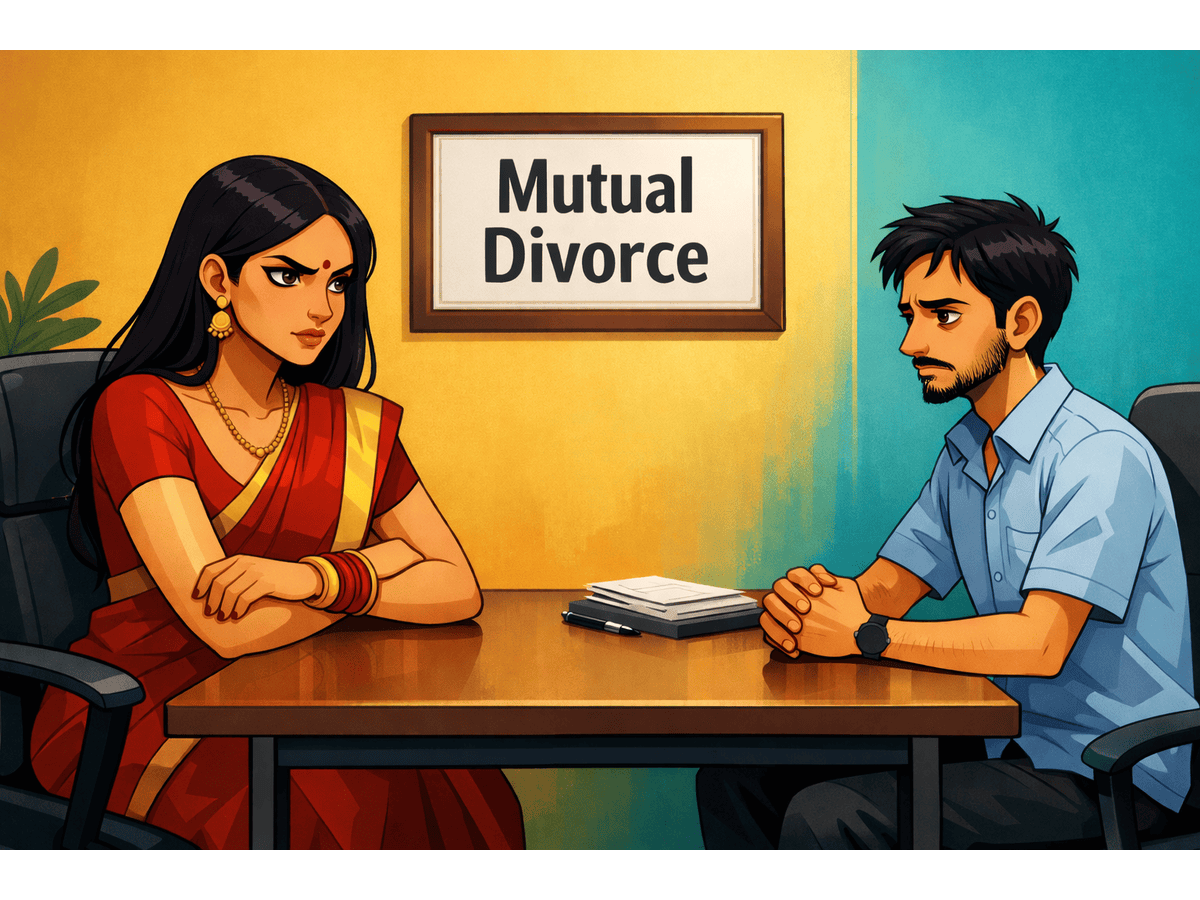
The Odisha High Court has quashed the criminal cases of 498A and dowry against a husband after he secured a mutual consent divorce. The court determined that continuing the criminal proceedings would be pointless since the marriage was legally dissolved by mutual agreement under the Hindu Marriage Act, thus ending a 14-year legal struggle. Justice Savitri Ratho of the Odisha High Court recently granted relief to Mr. Mishra, a husband from Puri, regarding the criminal cases (498A IPC) filed by his wife. The court noted that during the ongoing case, the couple had obtained a divorce by mutual consent.
In a judgment dated February 3, 2026, the Odisha High Court stated that since their marriage has been dissolved by a decree of divorce by mutual consent under Section 13B of the Hindu Marriage Act, it would not be sensible to keep the criminal case active. Consequently, the court quashed the criminal case and directed that a copy of this order be sent to the SDJM in Puri.
Mr. Mishra married on February 16, 2005, following Hindu traditions. After their marriage, his wife alleged that he demanded a dowry of Rs 5 lakh, but she could only provide Rs 2 lakh. She claimed that he threatened to kill her by dousing her with kerosene and making it appear as a suicide.
Following these allegations, the Kumbharapada police station registered case No-88/2012 under Sections 498 (A)/34 IPC and under Section 4 of the Dowry Protection Act. This police case led to a criminal case being filed in court (SDJM Puri, Case no. 626/2012). In response, he appealed to the Odisha High Court.
Advocate D.K. Swain, representing Mr. Mishra, argued before the Odisha High Court that there was no evidence supporting the dowry demand and that the allegations were false and vague. He contended that the dispute between the spouses stemmed from matrimonial incompatibility, which had been given a criminal context to harass him. His lawyer emphasized to the court that the couple had already obtained a divorce by mutual consent.
The Odisha High Court issued its judgment on February 3, 2026. The key portion of the judgment from the Family Court in Puri in C.P Case No. 164 of 2015 reads:
“The joint petition filed by the petitioner (wife) and respondent (husband) for dissolution of their marriage by a decree of divorce by mutual consent is hereby allowed. Their marriage solemnized on 16.2.2005 is hereby dissolved by a decree of divorce with effect from the date of the decree. Both the parties are free in all respect from that date.”
The Odisha High Court indicated that this extract from the Puri family court’s judgment clearly shows that the couple had resolved their differences and agreed to dissolve their marriage by mutual consent. Nearly ten years have passed since then.
Upon careful examination of the background facts and considering the Supreme Court’s decisions, the Odisha High Court concluded that since the marriage between the petitioner and the opposite party has been dissolved by a decree of divorce by mutual consent under Section 13B of the Hindu Marriage Act, no useful purpose would be served by keeping G.R. Case No. 626 of 2012 pending in the Court of the learned S.D.J.M., Puri.
The court determined that this was a suitable case for exercising power under Section 482 of the Cr.P.C. to quash the proceedings in G.R. Case No. 626 of 2012, which arose from Kumbharpada P.S. Case No.88 of 2012 and 1CC Case No. 56 of 2012.
Judgment: “The proceedings are accordingly quashed and the CRLMC is allowed. A copy of this order be sent to the learned SDJM, Puri.”