




Work plays a crucial role in human life, yet its impact on health and well-being is not well understood in India. The International Labour Organization (ILO) reports that more than two million workers globally die each year from work-related accidents and diseases. In India, nearly 48,000 workers lose their lives annually due to occupational hazards.
The Planning Commission’s Report for the Twelfth Five Year Plan (2012-2017) noted, “Occupational Health and Safety cover for the unorganised sector can well be said as non-existent.”
The ILO and the World Health Organization (WHO) define occupational health as the promotion and maintenance of the highest degree of physical, mental, and social well-being of workers across all occupations by preventing health issues, controlling risks, and adapting work to people.
Occupational hazards often extend beyond the workplace into homes and surrounding environments. Many occupational illnesses go undetected due to long latency periods, difficulties in distinguishing occupational from non-occupational diseases, and inadequate reporting systems.
Occupational health and safety is an interdisciplinary field focused on addressing workplace accidents, injuries, and illnesses. One measure taken to address these hazards in India was the establishment of the Employees’ State Insurance Corporation (ESIC), which provides medical and cash benefits for work-related injuries or diseases.
However, since the establishment of ESIC in 1952, the organised sector has diminished while the unorganised sector has expanded, with increased inter-State migrations. The ESIC primarily covers industrial and factory workers in the formal sector, leaving a vast majority of informal-sector workers unprotected.
Informal-sector workers, who make up over 90 percent of the workforce according to the National Commission for Enterprises in the Unorganised Sector, remain largely unprotected despite the Inter-State Migrant Workmen (Regulation of Employment and Conditions of Service) Act. Workplace safety is currently a pressing issue as four new Labour Codes have replaced previous laws.
Across India, millions of workers start their day in environments filled with dust, chemicals, noise, heat, and hazardous materials. These conditions contribute to the nation’s economic growth, yet those who endure them remain overlooked and unprotected.
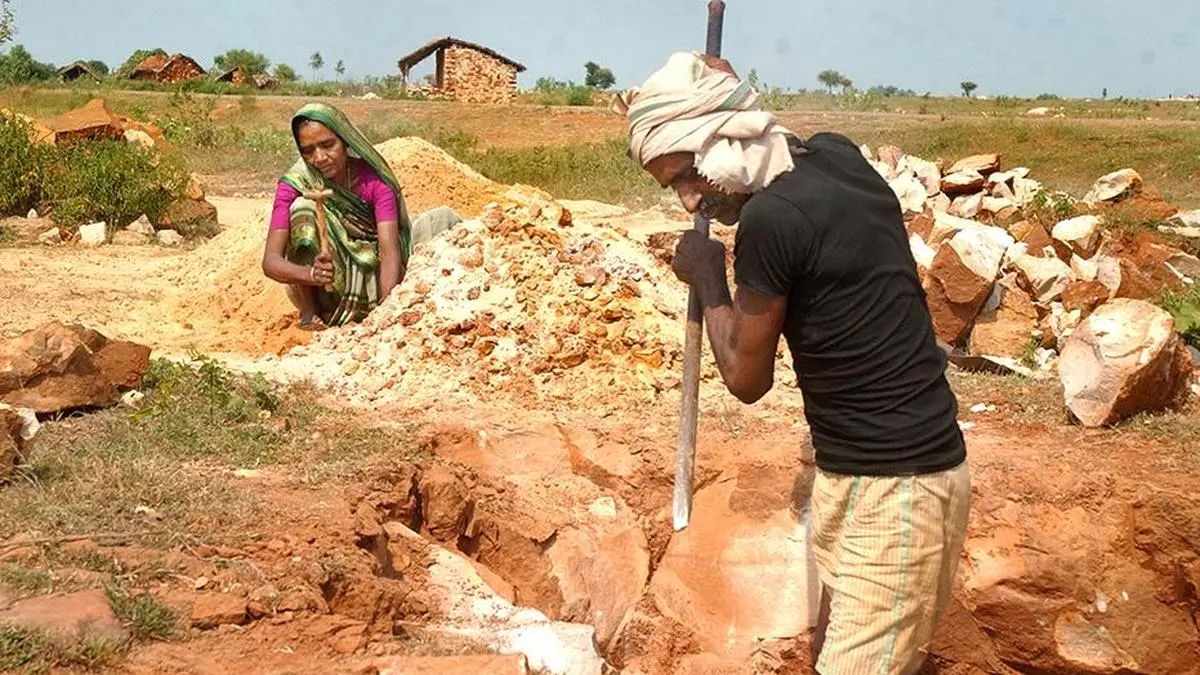
Informal-sector workers face poor ventilation, continuous dust exposure, hazardous chemicals, radiation, noise, and heat. This includes numerous migrant miners, stone crushers, construction workers, ramming-mass operators, slate pencil makers, and agate polishers, many of whom lack access to personal protective equipment and adequate medical surveillance.
Workers in mines are particularly vulnerable to hazardous dust, suffering from silicosis, pneumoconiosis, asbestosis, and occupational cancers. Other risks include hearing loss, dermatitis, and metal poisoning from exposure to various metals. Industrial workers also contend with noise, heat, dust, radioactive substances, and hazardous chemicals, with machines posing additional risks due to unguarded moving parts and high-pressure systems.
Informal-sector workers are largely excluded from occupational safety mechanisms. The Employees’ State Insurance (ESI) Act primarily overlooks informal-sector labor, while existing laws suffer from weak enforcement and lack of institutional capacity. Many workers in hazardous industries still lack adequate coverage despite the existence of the National Policy on Safety, Health and Environment at Workplace (2009) and laws like the Mines Act and the Factories Act, with enforcement remaining sporadic.
Compounding these issues is the lack of systematic efforts by authorities to gather reliable data on occupational injuries, illnesses, and deaths. An undated report by the ESIC estimates 17 million non-fatal occupational injuries annually in India—17 percent of the global total—and 45,000 fatal injuries, accounting for 45 percent of the world’s share. However, the report does not specify the study period.
This data is echoed in a study titled “Morbidity Profile, Economic Impact, and Social Security Scheme Utilisation of Occupational Injuries in a Tertiary Care Hospital in Bangalore, Karnataka,” which references a 1999 study for global estimates and a 2017 publication for India-specific data. Such inconsistencies highlight a deeper issue: the absence of a regularly updated national database on occupational injuries, diseases, and related deaths.
The Ministry of Labour & Employment and the Directorate General of Mines Safety (DGMS) have reported that over 235,447 mine workers are at risk of silicosis across 44,155 mines in various States and Union Territories. A national survey by the National Institute of Miners’ Health found a 40 percent prevalence of silicosis among mine workers, impacting 94,000 individuals. A primary investigation by the Union government estimated that 319,821 exposed workers across 21 States and Union Territories are likely to be affected by silicosis as of April 2017.
A 1985 study by the NIOH in Mandsaur, Madhya Pradesh, revealed alarmingly high mortality rates among slate pencil workers, with an average age of death at 35. Misdiagnosis of silicosis as tuberculosis (TB) complicates the crisis, resulting in incorrect treatment, denial of compensation, and disease progression. Individuals living near slate pencil factories, though not employed there, showed a significant prevalence of silicosis and related conditions. The NIOH study also indicated high levels of silica-containing dust in these areas.
Three decades later, a committee established by the Supreme Court in August 2016 regarding silicosis in Madhya Pradesh found airborne dust levels to be 40 to 50 times higher than permissible limits.
Many workers migrating from Madhya Pradesh to Gujarat and Rajasthan in search of employment have succumbed to silicosis and other occupational diseases. According to a 2017 study by the Silicosis Peedit Sangh, updated in December 2025, Madhya Pradesh alone reported 3,442 confirmed cases across six districts, with 1,467 fatalities over the past two decades, predominantly among individuals aged 19 to 35.