







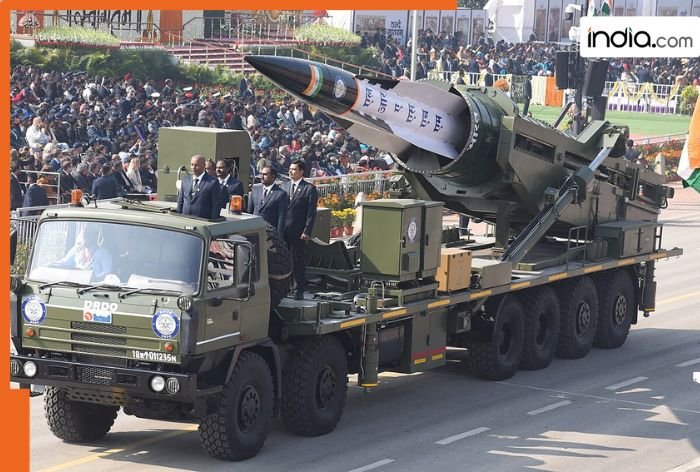
India is making strides in bolstering its defense capabilities across land, air, and sea. Under Mission Sudarshan Chakra, a National Air Defense System is in development and is expected to be operational within the next decade.
The country has seen remarkable advancements in its defense sector over recent decades, competing with leading nations in missiles, artillery, tanks, air defense systems, and warships. Indian leaders aim to achieve self-reliance in defense while also becoming an export-oriented nation. This objective has gained momentum in recent years, with global interest in India’s missile and anti-missile systems increasing. The BrahMos missile has attracted numerous buyers, and systems like Akash and Akashteer have gained a foothold in the international market.
India’s current focus is on three key areas: hypersonic missiles, next-generation fighter jets, and a national air defense system. Significant progress has been made in these areas, particularly in hypersonic missile development. To enhance maritime security, India plans to deploy the Long Range Anti-Ship Hypersonic Missile (Hypersonic LR-AShM), also known as an aircraft carrier killer, capable of destroying even China’s advanced Fujian aircraft carrier.
The indigenously developed Long Range Anti-Ship Missile (LR-AShM), created by the Defence Research and Development Organisation (DRDO), is set to enter the user trials phase with the Indian Navy. This hypersonic missile, with a range of approximately 1,500 kilometers, is anticipated to be a game-changer for India’s maritime security capabilities. Full induction of this missile system is expected by 2029-2030, with plans for limited coastal deployment before that to enhance maritime border security and protect vital sea lanes.
The LR-AShM is designed to target enemy warships and aircraft carrier strike groups from long distances. Reports suggest it will achieve hypersonic speeds of Mach 8 to Mach 10 (around 12,000 km/h), making it exceedingly difficult for modern naval air defense systems to intercept. With a strike range of about 1,500 kilometers, India will be able to target enemy vessels from significant distances.
User trials for the Indian Navy are expected to commence between 2027 and 2028, assessing the missile’s operational capabilities and accuracy under combat conditions. Following successful trials, limited production may begin. Experts believe this missile system could be crucial given the shifting strategic landscape in the Indo-Pacific region, as India continues to enhance its maritime deterrence capabilities.
This project, developed under the Atmanirbhar Bharat initiative, represents a significant achievement in promoting indigenous defense technology and reducing reliance on foreign systems. India is actively pursuing several advanced missile projects, including the LR-AShM, NASM-SR naval anti-ship missile, Pralay quasi-ballistic missile, and advanced submarine-launched missiles.
Recent successful tests of a long-range hypersonic anti-ship missile off the Odisha coast have further validated this program, demonstrating precise targeting and hypersonic speeds. These tests also showcased improved collaboration between DRDO and the Indian Navy. If the missile system is operational as planned, it could significantly enhance India’s maritime security and deterrence capabilities in the Indian Ocean region, strengthening coastal defense and response to potential maritime threats.
Source: India.com