






Puri is gearing up for the grand Deba Snana Purnima on June 29, a significant ritual leading up to the Rath Yatra. The sibling deities will undergo a sacred bath with 108 pitchers of water, followed by their majestic Hati Besha. This event marks their first public appearance, initiating a 15-day Anasara period for recuperation. Extensive security and crowd management measures are being implemented for the thousands of devotees anticipated to attend.
The annual Deba Snana Purnima, also referred to as Snana Yatra, is a major ritual that occurs before the Rath Yatra. During this festival, the sibling deities—Lord Jagannath, Lord Balabhadra, and Goddess Subhadra—will be ceremonially bathed at the Snana Mandap before donning the revered Hati Besha (elephant attire).
Celebrated on the full moon day of the Hindu month of Jyeshtha, Snana Yatra signifies the first public appearance of the deities outside the sanctum sanctorum of the Shree Jagannath Temple each year. This year, the festival will take place on June 29, approximately fifteen days prior to the Rath Yatra.
Preparations have been meticulously organized by the Shree Jagannath Temple Administration (SJTA), district authorities, and Odisha Police to ensure the rituals proceed smoothly and to manage the expected influx of devotees.
“We have made all arrangements for the smooth conduct of the festival. Servitors have pledged to complete rituals on time. Massive security and traffic measures are in place,” said SJTA Chief Administrator Dr. Arabinda Kumar Padhee.
Key Rituals
At least 23 rituals are scheduled to be performed during the festival. The day will commence before dawn with Mangala Arati, followed by Dwaralagi and Pushpanjali. The Pahandi Bije procession will then carry the deities from the Ratna Singhasana to the Snana Mandap amid chants of “Jai Jagannath” from thousands of devotees.
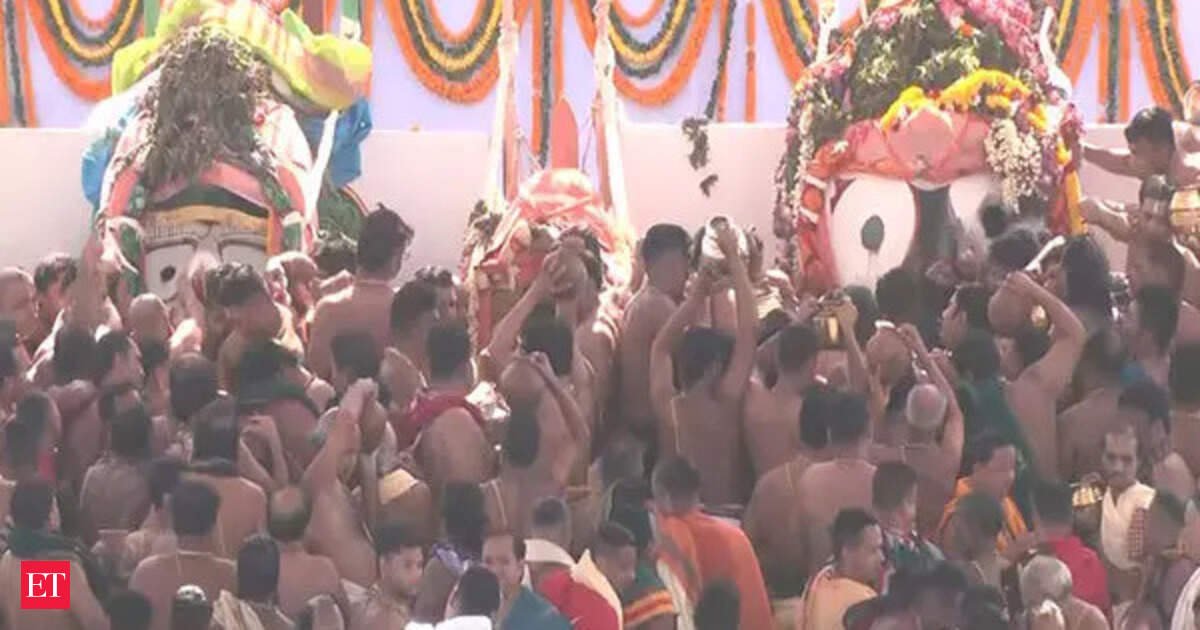
The central ritual, known as Jala Bije, involves bathing the deities with 108 pitchers of sanctified water sourced from the sacred Suna Kua. This water is purified and infused with sandalwood, aromatic herbs, and flowers.
The number 108 holds special significance in Hindu philosophy, symbolizing completeness and cosmic harmony.
Following the ceremonial bath, Lord Jagannath and Lord Balabhadra will be adorned in the Hati Besha, also known as Gaja Besha, while Goddess Subhadra will be decorated with a lotus-themed attire.
Significance of Hati Besha
According to temple tradition, the Hati Besha is associated with the legend of Pandit Ganapati Bhatta, a devotee of Lord Ganesha who visited Puri in the 15th century. It is believed that Lord Jagannath and Lord Balabhadra manifested in the form of Ganesha to fulfill his wish, giving rise to this annual tradition.
This attire also symbolically invokes the blessings of Lord Ganesha before the commencement of the Rath Yatra festivities.
Anasara Period Begins
After the Hati Besha, the deities will be taken to the Anasara Ghar, where they will remain out of public view for about 15 days. Temple tradition holds that the deities develop a divine fever following the ceremonial bath and undergo recuperation with Ayurvedic treatment.
During this period, devotees will worship representative images painted on tussar cloth, known as Patti Dian. These depict Lord Jagannath as Ananta Narayan, Goddess Subhadra as Bhubaneswari, and Lord Balabhadra as Ananta Basudev.
The deities will reappear during Netrotsav, also known as Nava Jaubana Darshan, on the eve of the Rath Yatra.
Security and Crowd Management
Authorities have bolstered security arrangements throughout Puri for the festival. Puri SP Prateek Singh stated that nearly 79 platoons of police personnel have been deployed for crowd management, traffic regulation, and security.
Special barricades have been set up around the Snana Mandap, and nearly 200 CCTV cameras have been installed across the city for surveillance. Dedicated response teams, anti-snatching squads, and striking forces are also on standby.
Devotees will be permitted to enter the temple through the Singhadwara, while general darshan inside the shrine will be suspended until around 2 pm to facilitate the uninterrupted conduct of rituals.
Snana Yatra is regarded as one of the most significant festivals in Jagannath culture, symbolizing purification, renewal, and divine compassion. The festival also marks the beginning of a sacred sequence of rituals culminating in the annual Rath Yatra.
Source: Economic Times