







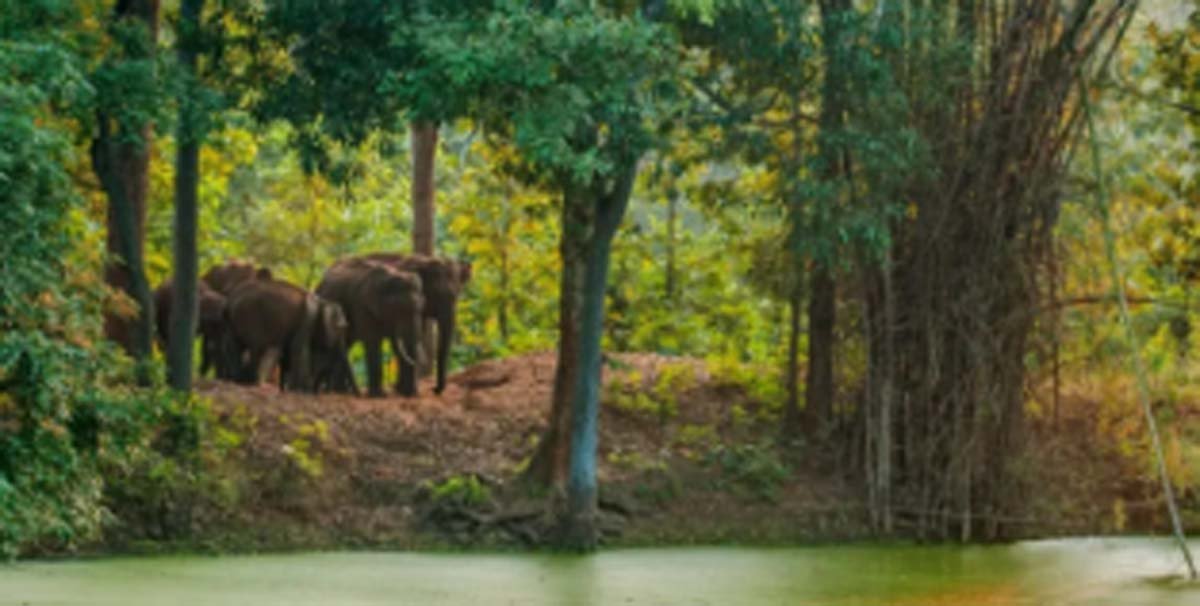
UPSC Essentials presents a series of subject-specific quizzes aimed at revising key topics from the static syllabus. Participate in today’s quiz on Environment and Geography to assess your knowledge.
QUESTION 1
Identify the primary habitats for elephants in India from the following regions:
- North-Eastern Hills and Brahmaputra Valley
- Western Ghats
- Shivalik Hills and Gangetic plains
- Western India
- Sundarbans Delta region
Choose the correct option:
(a) 1 and 2 only
(b) 1, 3, and 5 only
(c) 1, 2 and 3 only
(d) 1, 2, 3, 4 and 5
Relevance: This query is significant for the UPSC Prelims as it evaluates the geographical distribution and habitats of Asian elephants in India, aiding in understanding issues like human-elephant conflict and wildlife conservation.
Explanation:
On August 17, a Supreme Court bench led by Chief Justice Surya Kant instructed the Union government to initiate a new survey of elephant corridors, emphasizing that these pathways should remain unobstructed despite concerns over crop damage, as elephants naturally traverse large distances.
The bench was addressing a pending writ petition concerning human-elephant conflict management, which previously requested restrictions on harmful methods such as fireballs and spikes used to deter elephants. The August 17 directive required the Centre to report on measures taken to eliminate such ‘coercive measures’ that disrupt elephant movements.
Asian elephants are known for their mobility and social behavior. The average range for a male elephant spans between 50 and 300 square kilometers, depending on resource availability. These movements can occur in herds or solo and vary based on habitat type, food, water sources, population density, and human interference.
Research from the National Centre for Biological Sciences and the Wildlife Institute of India indicates that elephant movement patterns are heavily influenced by the seasonal availability of food and water. For example, it is common for elephants to migrate to Kerala during dry seasons seeking sustenance in the lush forests of the Western Ghats, as highlighted in a recent report from the Environment Ministry.
India has four major landscapes for elephant populations: the Western Ghats, North-Eastern Hills and Brahmaputra floodplains, Shivalik Hills and Gangetic plains, and Central India and Eastern Ghats. Over 50% of the country’s 22,446 elephants reside in the Western Ghats across Karnataka (6,013), Tamil Nadu (3,136), and Kerala (2,785).
Thus, the correct answer is (c).
QUESTION 2
Regarding the Bonn Challenge, evaluate the following statements:
- It is applicable only to countries that have ratified the Paris Agreement, requiring them to submit annual restoration reports.
- India has committed to restoring 13 million hectares by 2020, with an additional eight million hectares by 2030.
- It is a legally binding agreement under the United Nations Framework Convention on Climate Change (UNFCCC).
How many of these statements are accurate?
(a) Only one
(b) Only two
(c) All three
(d) None
Relevance: This question is pertinent for the UPSC Prelims, evaluating knowledge of global environmental initiatives, land restoration, and India’s commitments on the international stage.
Explanation:
The Bonn Challenge, initiated in 2011, sees over 70 countries pledging to restore 150 million hectares of degraded land by 2020, with a target of 350 million hectares by 2030. India has agreed to restore 13 million hectares, plus an additional eight million hectares by 2030, confirming statement 2 as accurate.
The Bonn Challenge is a voluntary global restoration program and is not restricted to Paris Agreement signatories, nor does it mandate annual reports, making statement 1 incorrect.
Additionally, it is not a legally binding agreement under the UNFCCC, rendering statement 3 also incorrect.
Therefore, the correct answer is (a).
QUESTION 3
What factors contribute to changes in shorelines?
- Tides
- Port construction
- Sand mining
- Cyclone storms
Select the correct option:
(a) 2, 3 and 4 only
(b) 1, 2, 3, and 4
(c) 2 and 3 only
(d) 1 and 4 only
Relevance: This question assesses foundational knowledge in coastal geomorphology and shoreline dynamics, key factors in understanding coastal vulnerability and disaster management.
Explanation:
Shoreline changes are the result of ongoing interactions between land and water, influenced by natural phenomena such as tides and storms, as well as human actions like port construction and sand mining. Factors such as global sea-level rise also play a significant role in coastal erosion and shifting shorelines.
A 2021 study titled “Shoreline Change Along Odisha Coast” published in the Journal of Earth System Science indicates that coastal structures like sea walls and jetties alter shoreline and beach morphology, with significant impacts from hard structures built for port development. Moreover, natural disasters, including cyclones, cause drastic shoreline changes, particularly along Odisha’s coast, which is highly vulnerable to such events.
Thus, the correct answer is (b).
QUESTION 4
What advantages do floating solar projects offer?
- Land conservation
- Reduced water evaporation
- Increased dissolved oxygen content in reservoir water
- Enhanced solar module efficiency
- Complete prevention of aquatic weed growth
Select the correct option:
(a) 1, 3 and 5 only
(b) 1, 2, 4 and 5 only
(c) 1 and 5 only
(d) 1, 2 and 4 only
Relevance: This question evaluates knowledge of renewable energy, floating solar technology, and its environmental impacts, critical for understanding the benefits and limitations of clean energy technologies.
Explanation:
India’s solar capacity has expanded significantly, from 3 gigawatts (GW) in 2016 to over 160 GW in 2026, primarily through large-scale initiatives. However, the competition for land with urban development and agriculture makes it increasingly challenging to establish new solar projects while maintaining ecological conservation.
The recent launch of the Pradhan Mantri Surya Sarovar Yojana (PM-SSY) demonstrates the government’s commitment to promote land-efficient solar solutions, aiming to produce 5,000 megawatts (MW) of floating solar energy with a budget of Rs 5,070 crore, marking the first national initiative focused on scaling floating solar technologies.
This scheme will also integrate energy storage systems with a minimum capacity of two hours, equivalent to 10,000 megawatt-hours (MWh).