




In many households, disagreements between spouses are commonplace. For instance, when a husband comes home late after spending time with friends, it’s understandable that his wife might feel upset. This relatable sentiment is mirrored in the divine relationship of Goddess Lakshmi and Lord Jagannath.
During the grand celebration of Rath Yatra, Lord Jagannath departs from his temple, engaging with thousands of devotees and spending time with his siblings at Gundicha Temple, which is essentially his aunt’s residence. In this process, he inadvertently prolongs his stay, leaving Goddess Lakshmi in waiting. This human-like emotion is expressed through the significant ritual of Hera Panchami. On the fifth day of Rath Yatra, Goddess Lakshmi visits Gundicha Temple to confront her husband, who neglected to take her along during the chariot procession. In a poignant act of discontent, she symbolically damages a part of the Nandighosha chariot, which is Lord Jagannath’s grand chariot, before returning to the Srimandir.
Ommcom News delves into the distinct Hera Panchami ritual that vividly illustrates the celestial drama and the affectionate quarrel between the divine pair.
The Evolution of Hera Panchami Within Rath Yatra
As per ancient writings found in ‘Ratha Chakada’, the Hera Panchami ritual was significantly transformed by King Kapilendra Deb, who elevated it from a simple chanting event to a grand celebration. Since his reign, this ritual has become a pivotal part of the Rath Yatra festivities. Notably, Hera Panchami marks the ceremonial commencement of the Bahuda Jatra, when the chariots are directed southward during the Dakhina Moda, signifying the deities’ return to the temple.
This ritual also made its mark in journalistic history. On July 28, 1888, Utkal Deepika, the first vernacular daily in Odisha, published the earliest known article about Hera Panchami, marking the start of systematic coverage of the region’s cultural traditions.
The Mythology Behind the Hera Panchami Ritual
Experts in Jagannath culture explain that Goddess Mahalakshmi represents the feelings of an Odia wife. She experiences heartbreak when Lord Jagannath embarks on Rath Yatra with his siblings, leaving her behind in Srimandir. Their wedding is celebrated on Jyeshtha Shukla Ekadashi. Shortly after, following the ‘Chaturthi Snana’ on Jyeshtha Purnima, both deities fall ill. They remain in Anasara Gruha for the next 15 days. Once healed, the Lord appears in Naba Joubana Besha, but by this time, Mahalakshmi’s sorrow has intensified; the Lord has departed for his annual journey without informing her, mirroring a wife’s yearning for her husband.
Additionally, Jagannath culture specialists note that after four nights without the Lord’s return, Goddess Bimala intervenes. As the Tantric consort of Jagannath and guardian of Srimandir, she provides Mahalakshmi with Mohana Churna to expedite his return. She conveys to the goddess, ‘Aou Dukha Na Kara Go Bishnu nka Gharani, Mohechurna Basibhuta Hebe Tha Jani’.
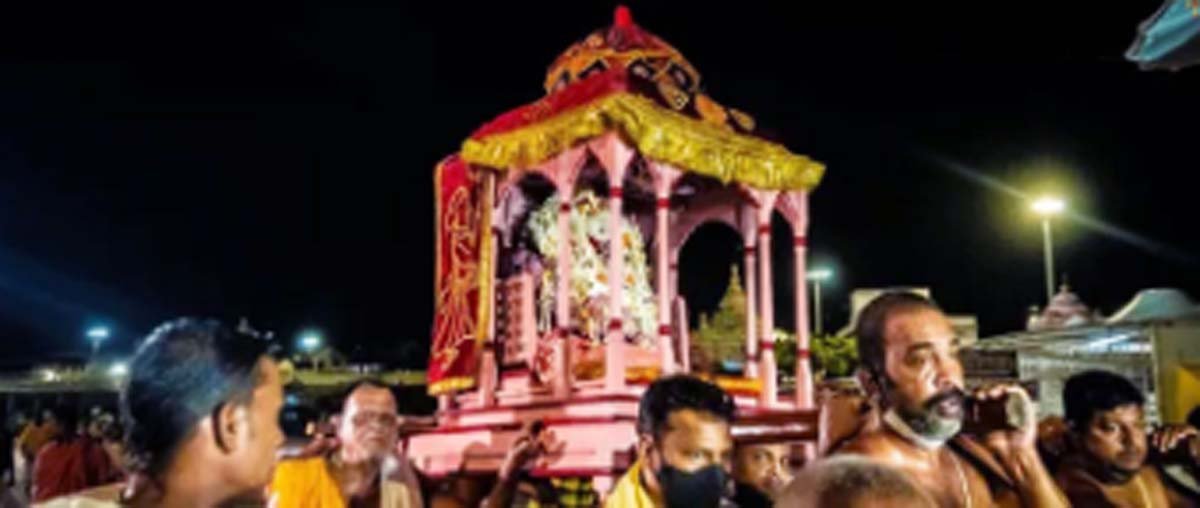
Following the guidance of Lord Brahma, Goddess Mahalakshmi heads to Gundicha Temple where Lord Jagannath is with his siblings. Brahma had once stated, “One glimpse of Lord Jagannath at the Adapa Mandap equals a hundred darshans at the Ratna Mandap.” Motivated by this idea, Mahalakshmi decides to see her husband. In the evening, a vibrant procession makes its way down Bada Danda, with servitors carrying the Goddess in an ornately decorated palanquin to Gundicha Temple. Upon her arrival, she throws ‘Mohana Churna’ to attract her husband and receives a garland of consent (‘Agyan Mala’) from Lord Jagannath. However, feeling slighted and frustrated due to his neglect, she instructs her servitors to damage part of his chariot as a lesson.
Later, filled with guilt for her actions against the sacred chariot, she discreetly departs. Eschewing the celebratory atmosphere, she returns to Srimandir alone through Hera Gohiri Sahi, her pride diminished and her anger replaced by remorse.