





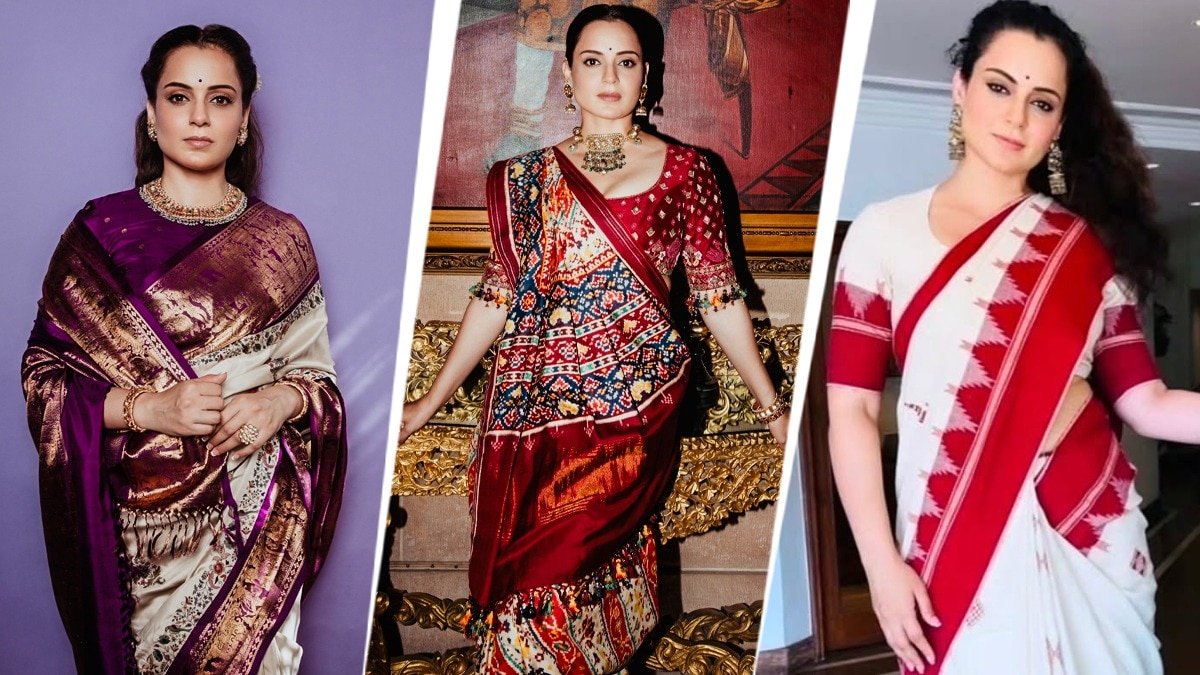
Kangana Ranaut once again harnessed the power of fashion to honor India, this time during the promotional events for her newly released film Bharat Bhhagya Viddhaata.
The actor and BJP MP donned an eye-catching and inspiring collection of sarees throughout the film’s promotions, each piece celebrating India’s rich craftsmanship and transforming the entire press tour into a sartorial journey across the nation.
A Kanjeevaram
To kick off the promotions, she chose a regal violet-and-ivory Kanjeevaram saree designed by Gaurang Shah. The bright purple border contrasted beautifully with the understated ivory expanse, shimmering with intricate zari embroidery featuring temple-inspired motifs. However, the saree’s allure extended beyond its initial appeal.
Shah, a textile revivalist celebrated for his advocacy of traditional weaves and handcrafted textiles, infused the South Indian classic with elements from Western India. The designer adorned the regal drape with delicate yet vibrant Mochi embroidery motifs.
Mochi embroidery is a traditional craft from the Kutch region of Gujarat, historically practiced by the Mochi (cobbler) community. Known for its fine chain-stitch work, this embroidery technique employs a hooked needle called an aari instead of a conventional sewing needle.
Odisha’s Kotpad saree
Next, she wore a Kotpad saree from Odisha. While the white-and-red drape appeared effortlessly elegant, its beauty was merely part of the narrative. The true charm of Kotpad sarees lies in the labor-intensive craftsmanship and centuries-old techniques involved in their creation.
As one of India’s rare tribal textiles, Kotpad sarees are valued for their natural dyeing process, handwoven craftsmanship, and deep cultural significance. The distinctive dyeing technique utilizes extracts from the roots and bark of the aal tree, resulting in earthy shades of maroon, rust, brown, black, and deep red. This process is labor-intensive and entirely natural.
Traditionally woven by the Mirgan weaving community in the Kotpad town of Odisha, every Kotpad saree is handwoven and takes weeks to complete. The motifs on these sarees, which include crabs, fish, birds, and tribal patterns, serve not only as decoration but as cultural reflections.
Long before sustainability became a fashionable term, Kotpad sarees embodied it through the use of natural dyes, handmade production processes, locally sourced materials, and minimal environmental impact.
The luminous Paithani
Ranaut continued her saree showcase with a luminous Paithani saree from Maharashtra, exclusively woven for her by designer Neeta Lulla’s team in shades of saffron gold and gulnar red. It featured traditional ‘Mor-Phool’ motifs, where elegant peacocks intertwine with flourishing florals.
Paithani is regarded as one of Maharashtra’s most cherished textiles. Made from fine silk and metallic zari, these sarees are known for their lustrous sheen and heirloom quality. Unlike many sarees where motifs are embroidered or added later, Paithani motifs are woven directly into the fabric by hand. The weaver interlocks different colored threads to create intricate designs, a meticulous process that can take months.
Regal in Patan Patola drape
Another standout piece was a Patan Patola silk saree in a rich red hue, which Ranaut wore for her film’s promotions in Jodhpur, exuding an air of royalty.
She opted for a handwoven Patan Patola saree, one of Gujarat’s most esteemed textile traditions, crafted using the rare double ikat technique. She paired it with a raw silk blouse, hand-embroidered with traditional Patan motifs rendered in beads and pearls.
Ranaut’s outfit selections are not merely a showcase of textiles across India; they serve as a lesson. At a time when fashion often pursues the latest trends, Kangana Ranaut turns to traditions that have withstood the test of time. It serves as a reminder that India’s greatest luxury lies not in labels or trends, but in the artistry of its weavers and craftspeople.