







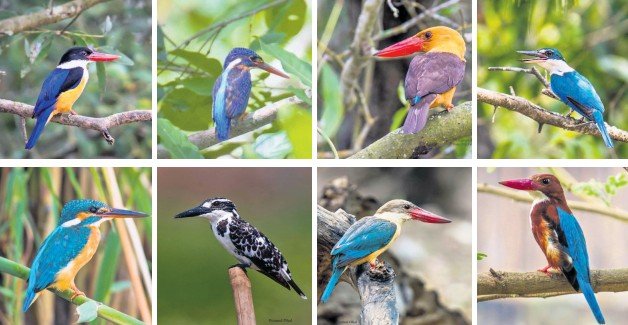
In a positive development for environmentalists and bird watchers, Bhitarkanika National Park has recorded the presence of eight species of kingfishers, establishing it as an important habitat for these birds. India is home to 12 kingfisher species, with eight found in Odisha.
All species were observed within the 672 sq km area of Bhitarkanika. A census conducted by the Forest department in August 2025 noted a total of 1,30,796 birds in the national park during the monsoon season. The count of kingfishers saw an increase of 37 compared to the figures from 2024.
Known for their rapid hunting abilities, kingfishers are often seen diving from mangrove branches into the water to catch their prey before returning to their perches, a behavior that captivates visitors. Ornithologist Pramod Kumar Dhal remarked, “While one or two species of kingfishers are commonly seen across different parts of Odisha, Bhitarkanika uniquely hosts as many as eight species.”
The species recorded in the park include the black-capped kingfisher, stork-billed kingfisher, white-throated kingfisher, pied kingfisher, common kingfisher, collared kingfisher, brown-winged kingfisher, and blue-eared kingfisher. Notably, the collared kingfisher and brown-winged kingfisher are rarely observed outside Bhitarkanika. However, their populations remain low, and the blue-eared kingfisher was not sighted during the latest census.
Kingfishers primarily feed on fish, prawns, crabs, small insects, and aquatic larvae found in rivers and coastal waters. Characterized by large heads, long beaks, and short legs, these birds prefer perching on branches rather than walking on the ground. Their activity peaks between November and February, and they are frequently seen waiting for prey on low-hanging branches of mangrove trees near water channels.
Experts highlight that kingfishers can carry prey heavier than their own body weight. Nevertheless, their populations are gradually declining due to various factors. Pollution from industrial discharge and shrimp farming poses a significant threat to their survival, along with habitat loss, decreasing forest cover, and reduced water levels in rivers and canals, according to Dhal.