



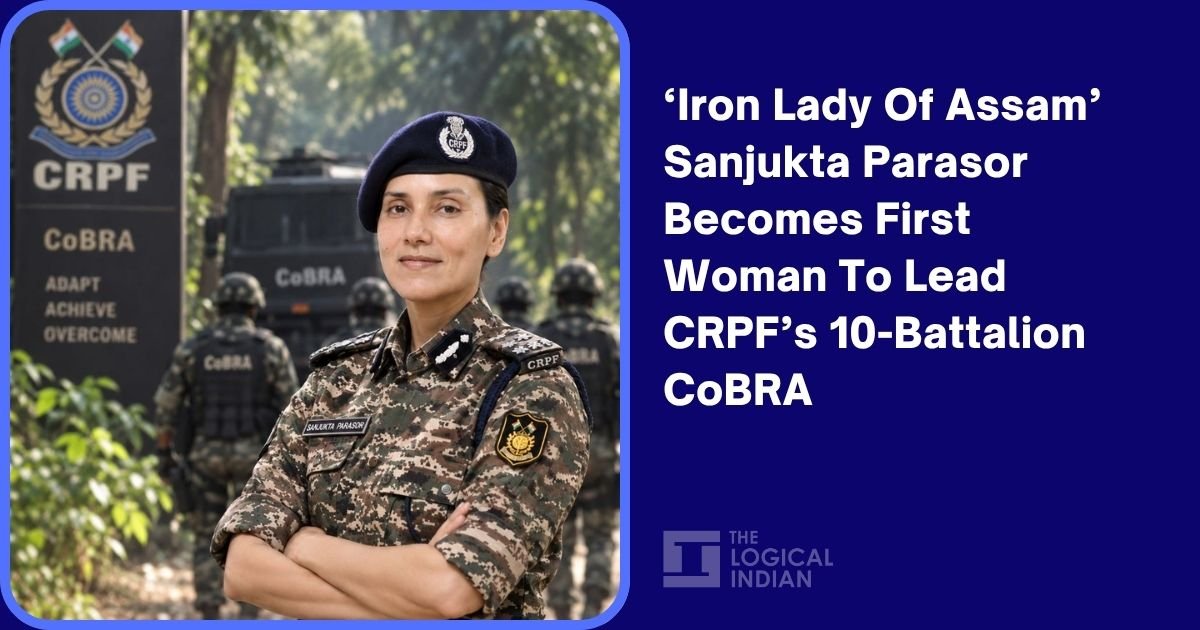
Senior IPS officer Sanjukta Parasor has officially taken on the role of Inspector General of the Central Reserve Police Force’s (CRPF) elite team, the Commando Battalion for Resolute Action (CoBRA), marking a significant milestone as the first woman to lead this specialized jungle-warfare unit. A member of the 2006 Assam-Meghalaya cadre, Parasor is equipped with a wealth of experience in counter-insurgency, field policing, and national security investigations.
She succeeds Danesh Rana, an officer from the 1996 batch, following her appointment by the CRPF headquarters last week. This historic appointment comes as CoBRA continues its operations in challenging forest terrains and regions affected by insurgency, notably in places like Manipur. A senior CRPF official confirmed that this is the first instance of a woman heading the ten-battalion force.
Parasor’s career trajectory has been shaped by her work in some of the most exigent security contexts in India. Hailing from Assam, she earned her degree in Political Science from Indraprastha College for Women at Delhi University and later pursued a master’s in International Relations at Jawaharlal Nehru University. Achieving an impressive All India Rank of 85 in the UPSC Civil Services Examination in 2006, she joined the Indian Police Service as part of the Assam-Meghalaya cadre.
Her initial postings in Assam provided her with firsthand exposure to areas troubled by armed insurgency, compelling her to navigate difficult terrain and challenging security conditions. As Superintendent of Police in Sonitpur, she spearheaded counter-insurgency initiatives against the National Democratic Front of Bodoland (NDFB), during which she was reported to have led operations that resulted in the elimination of 16 militants and the apprehension of 64 others. Her proactive involvement in these operations earned her the nickname, the “Iron Lady of Assam.”
Beyond her field experience, Parasor has also worked with the National Investigation Agency (NIA), focusing on national security matters. A government record from Assam indicates her deputation to the NIA, where she served as a Deputy Inspector General. This role provided her with exposure to investigations pertaining to terrorism and extremist networks, as well as facilitating collaboration among various security agencies. Prior to her assignment with CoBRA, she was heading the Criminal Investigation Department (CID) of the Assam Police. Her unique blend of hands-on counter-insurgency experience and investigative expertise positions her adeptly to lead a force tasked with operating in some of the country’s most challenging environments.
CoBRA, an acronym for Commando Battalion for Resolute Action, is a specialized unit within the CRPF designed for guerrilla and jungle warfare. Established between 2008 and 2011, the CRPF formed ten CoBRA units, which are deployed in areas suffering from Left Wing Extremism and insurgency. Personnel undergo rigorous training in commando tactics and jungle warfare, preparing them for long-range patrols, intelligence-driven operations, ambushes, counter-ambushes, and missions in regions where improvised explosive devices are a concern.
The force has played a crucial role in anti-Maoist initiatives across states like Chhattisgarh, Jharkhand, Odisha, and Maharashtra. Recent reports indicate that CoBRA is actively involved in securing large forest areas that have been reclaimed from Maoist influence, with two of its units currently stationed in Manipur amidst ongoing armed conflicts.
The Ministry of Home Affairs has acknowledged that intelligence-led jungle and guerrilla operations carried out by CoBRA have significantly contributed to the campaign against Left Wing Extremism, which the government noted had reached a key milestone as of March 2026.
Sanjukta Parasor’s ascent to this pivotal role in CoBRA introduces a female officer with comprehensive field and investigative backgrounds into a senior command position historically dominated by men. Her journey from academic pursuits through the civil services to challenging field roles in national security and now leading CoBRA exemplifies the expanding opportunities for women within India’s security framework.
Nonetheless, security operations in conflict-prone regions entail responsibilities beyond mere operational effectiveness. Safeguarding civilians, engaging with local communities, minimizing violence, and fostering environments conducive to dialogue and peace are essential components alongside security duties.
As more women assume leadership roles in demanding public service positions, it raises the question: What further measures can organizations implement to ensure equal opportunities while prioritizing empathy and community trust in public service?