



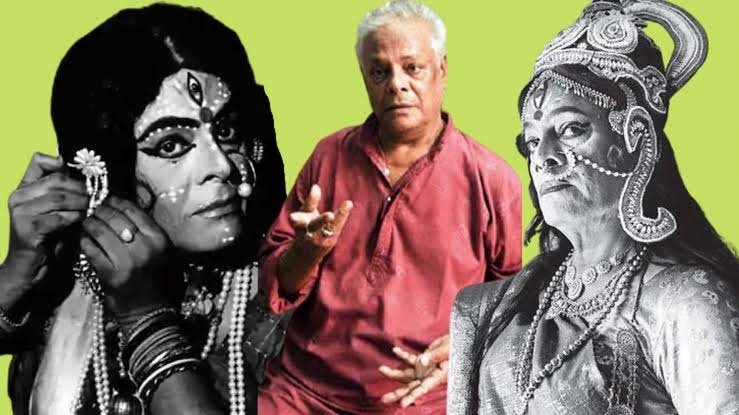
For Rakhal Chandra Das, who graced the stage as Rakhal Rani, Jatra represented more than just a career; it embodied a way of life.
With a career that stretched over 35 years, Rakhal first took to the stage at just seven years old, earning recognition for his elegant and committed performances. He was part of a legendary group of male performers who specialized in portraying female characters during a time when men overwhelmingly occupied these roles in Jatra. His peers included notable figures like Chapal Rani and Chhabi Rani.
In 1973, the West Bengal government honored Rakhal for his contributions to the art form. However, like many of his contemporaries, he ultimately faced hardship and marginalization as the landscape of Jatra shifted to include more women performers.
In the 2014 Bengali documentary Chena Kintu Ajana directed by Dipankar Dutta, Rakhal’s son, Babulal Das, recounts the challenges his father encountered after leaving the Jatra scene. “I remember my father working at a small grocery store after quitting (Jatra), but he couldn’t maintain that role for too long. He even attempted selling peanuts for a few days, but that didn’t work out either.”
Eventually, Rakhal found support from renowned playwright Brajendra Kumar Dey, who helped him secure a position as a peon at North Land High School in Ichapur. Rakhal passed away on November 30, 1984.
But Rakhal’s narrative is reflective of a broader phenomenon experienced by generations of female impersonators who dedicated themselves to Jatra, only to find their livelihoods diminished as the tradition began to fade.
Origins of Jatra
Jatra is a folk theatre tradition primarily associated with eastern India, particularly in regions like Bengal, Assam, and Odisha.
The roots of Jatra can be traced back to the 15th and 16th centuries when Mahapurusha Shankaradeva established a dramatic tradition called Ankia Nat. His disciples referred to some of these plays as Yatras, including titles such as Kalidamana Yatra and Arjunabhajan Yatra.
In Bengal, Jatra became intertwined with Gaudiya Vaishnavism and devotional performance, incorporating hymns from significant texts like Jayadeva’s Gita Govinda. In the History of Indian Theatre (1987), scholar Manohar Laxman Varadpande notes that the term is believed to originate from ritualistic musical processions during religious festivals.
Over time, Jatra evolved into one of Bengal’s most iconic forms of folk theatre.
The ‘Purush Ranis’
To grasp the significance of female impersonators in Jatra, it is essential to explore the dynamics of masculinity and femininity within the art form.
In her 2024 paper, The Last Jatra of the Purush Ranis: A Dying Art of Female Impersonation, Stithirupa Mukherjee, a postgraduate English literature student at Jadavpur University, argues that the fluidity of gender identities is central to ancient Indian mythology. The concept of Ardhanarishvara, representing the combined form of Shiva and Parvati, provides a cultural lens through which cross-gender performances can be appreciated.
Several factors contributed to the prevalence of male performers in female roles within Jatra. Mukherjee points out that the exclusion of women from theatre created a necessity for male impersonators.
Sandip Roy, author of Chapal Rani: The Last Queen of Bengal (2026), identifies two key reasons for the rise of female impersonators: societal reluctance to allow women to travel alone with theatre groups and the demand for powerful voices capable of reaching large audiences.
This led to the emergence of the Purush Ranis, male actors renowned for their portrayals of women.
Female characters in Jatra were often referred to as ‘Rani’, meaning queen or elegant lady, a term that eventually came to signify male actors specializing in female roles.
The Decline of the Ranis
The tradition of female impersonation began to shift as societal perceptions of women in performance evolved. More women began to enter Jatra, gradually assuming female roles themselves, although this transition was met with resistance.
Bengali scholar and former performer Prabhat Kumar Das, in his work Life of Jatra Actresses: Stories of Unending Struggle (1950s-2010s), notes that the tradition of male impersonation saw a decline particularly during the 1960s and 1970s.
He attributes the economic downturn in Jatra to multiple factors, including the partition of Bengal and the abolition of zamindari post-independence. While women were being integrated into Jatra troupes, proprietors remained skeptical about the commercial viability of replacing male impersonators. However, the advancing age of many male performers eventually paved the way for women to take over these roles.
This transition altered the socioeconomic framework of Jatra. Performers who had achieved legendary status through remarkable performances since the mid-1950s found themselves gradually edged out of an industry to which they had devoted their lives.
One significant figure in this evolution was Jyotsna Dutta, an actress and singer whose success catalyzed the commercial acceptance of female performers. Das notes that Dutta’s prominence as the lead in Satyambar Opera encouraged the troupe to cast women in female roles, a trend that soon spread to competing companies. This shift helped formalize the role of ‘theatre actress’, with talents like Chhabi Roy, Bina Ghosh, Uma Mukherjee, Bela Sarkar, Chitra Mallik, and Firozabala emerging as leading stars.
Not everyone embraced this change.
Dey, a well-known Jatra playwright, expressed opposition to the inclusion of women in the art form, arguing that their presence alongside the traditionally nomadic and nocturnal lifestyle of Jatra would lead to complications. He believed that the profession should remain male-dominated and lamented the loss of female impersonators, whom he viewed as integral to Jatra, claiming that the introduction of women performers sowed the seeds of its downfall.
His perspective faced criticism from contemporary Jatra artists. The discussion shifted from who could portray which characters to how the changing social and economic landscape would reshape the very nature of Jatra.
As Jatra became more commercialized, it also became a space for financial investment, including the flow of unaccounted money.
In his book, Das references an article from Anandabazar Patrika dated August 26, 1960, which criticized the inclusion of women in Jatra, cautioning against the emergence of unethical contracts. “Those offering money in advance wish for female roles to be filled by women. While the addition of actresses does increase the fees, it has led jatra troupes to compromise their artistic values,” the article stated.
Das also cites a protest essay in the Bengali performing-arts journal Jatrajagat, penned by veteran performer Shib Bhattacharya and endorsed by female artists. The essay denounced what it termed the ‘rude gesture’ of Dey’s opposition to women entering Jatra.
“Women have long been part of the acting profession. It is evident that Brajendra Kumar is unaware of their relationships with their male counterparts, leading him to make misguided statements about their roles in the industry.”