



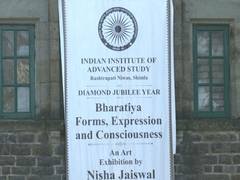
Shimla (Himachal Pradesh) [India], October 12 (ANI): The Indian Institute of Advanced Study (IIAS) is currently celebrating its Diamond Jubilee with a five-day event at Rashtrapati Niwas in Shimla, showcasing a blend of art, history, literature, culture, and academic inquiry. This celebration, taking place from October 11 to 15, aims to engage scholars, artists, researchers, and the public in a deeper exploration of India’s rich cultural and intellectual legacy.
As the festivities progressed to their second day, the event featured an array of activities including an art exhibition, a book fair, the release of new publications, and lectures covering various academic and cultural topics.
The initiative focuses on bridging the institute’s academic pursuits with broader public engagement, emphasizing Indian philosophical traditions, the Bharatiya Knowledge System, and the importance of cultural preservation.
Nisha Jaiswal, an internationally acclaimed artist whose works are part of the exhibition, shared that her art reflects themes of “Indian Expression and Consciousness,” drawing inspiration from Indian philosophy and the significant meanings found within mythology and religious symbols.
In an interview with ANI, Jaiswal explained that her paintings go beyond mere visuals; they express messages related to inner consciousness, self-awareness, purity, devotion, and the life cycle. “Every painting carries a message. Our philosophy emphasizes awakening inner consciousness. While these are visual works, each carries deeper meanings for viewers to explore,” she stated.
One of her pieces, featuring the Sun God, symbolizes the continuity of life through imagery of the Sun and his seven horses. Jaiswal noted that symbols such as the conch, lotus, and trident represent inner awareness, purity, and the ability to navigate life’s ups and downs. “The Sun rises and sets, just as our lives progress through various phases. We must stay conscious and aware in every situation,” she remarked.
Jaiswal also discussed the ethical and social messages inherent in Indian mythology, referencing a painting of Ram Darbar that embodies ideals of dignity, duty, service, righteousness, and social harmony. The depiction includes not only Lord Ram and Sita but also other notable figures, illustrating the principle of collective coexistence and the philosophy of ‘Vasudhaiva Kutumbakam’—the world as one family.
“Our mythological narratives are more than stories; they communicate profound insights about our inner consciousness, social responsibility, and the importance of living harmoniously,” she added.
Describing her artistic journey as both a devotional and spiritual endeavor, Jaiswal emphasized that her work requires immense concentration, patience, and dedication. Some of her pieces took between two to three years to finish, while the Ram Darbar composition took an impressive seven years to complete. “Every line and stroke demands focus. For me, this is a way to connect with the divine, requiring complete surrender, devotion, and sustained effort,” she explained.
Jaiswal expressed the significance of showcasing her art at the IIAS, given the institute’s rich intellectual environment and the chance to interact with scholars who can discern the philosophical dimensions of her work. She encouraged young individuals to delve into the deeper meanings of Indian culture and mythology, rather than only viewing them superficially.
IIAS Director Professor Himanshu Kumar Chaturvedi remarked that the Diamond Jubilee celebrations were crafted to make the institute’s intellectual resources and cultural heritage more accessible to the public. The event includes lectures from prominent scholars, alongside exhibitions and activities designed to foster public engagement with art, culture, and academic research.
Chaturvedi specifically highlighted Jaiswal’s exhibition as a vital contribution to promoting Indian art and cultural appreciation, noting that her depiction of Ram Darbar is among the works available for exhibition in Shimla.
The director also mentioned the institute’s efforts to promote Kangra miniature painting, a significant art form from Himachal Pradesh, with an exclusive gallery set to open on October 15, inaugurated by the Governor. “Our goal is to bring the institute’s resources, art, and culture to the public and create opportunities for interaction. That is why entry is free for all activities, whether for the art exhibition or the book fair,” he stressed.
Chaturvedi reiterated the institute’s commitment to preserving and promoting Himachal Pradesh’s cultural heritage, including its traditional scripts and Kangra art. The new gallery will enhance the visibility of the region’s artistic legacy, introducing it to a broader audience both nationally and internationally.
With Rashtrapati Niwas attracting numerous visitors annually, there is a unique opportunity to showcase the region’s heritage alongside the institute’s academic contributions. Chaturvedi emphasized the importance of IIAS’s publication program and its involvement in international academic conferences. He noted that the institute continues to produce significant scholarly works that contribute to advanced research.
Furthermore, the institute is enhancing research on historical manuscripts and primary sources. Chaturvedi mentioned an original manuscript related to the Mahabharata, linked to a fellow from Odisha, which has been dedicated to the institute’s library, with plans to format it for research purposes. The institute is also working on establishing a dedicated collection of Himalayan manuscripts as part of a national effort to preserve, study, and translate historical documents.
This initiative could signify a new chapter in the institute’s research endeavors by bolstering manuscript preservation and translation efforts, promoting future scholarship.
Chaturvedi also outlined plans for a greener campus through electric mobility, announcing the acquisition of an electric vehicle with corporate social responsibility support, along with three additional electric vehicles. This initiative aims to enhance visitor convenience while mitigating the environmental impact of vehicles within the heritage campus.
Moreover, the institute is exploring ways to introduce visitors to Indian knowledge traditions through exhibitions that elucidate the significance of classical Indian texts and intellectual traditions in an engaging manner.
Indian archaeologist Vasant Shinde, speaking with ANI, praised the IIAS as a crucial institution for advanced research and higher education in India, especially in the social sciences and interdisciplinary studies. He noted that the institute has maintained high academic standards over the years, providing a platform for scholars from diverse disciplines and backgrounds to exchange ideas and advance their research.
Shinde remarked, “The institute has significantly contributed to deep research in India. Researchers aiming for serious, original work should have the opportunity to come here, collaborate with scholars, and benefit from this intellectual environment.” He emphasized that the Diamond Jubilee celebrations present a valuable opportunity for such engagements.