


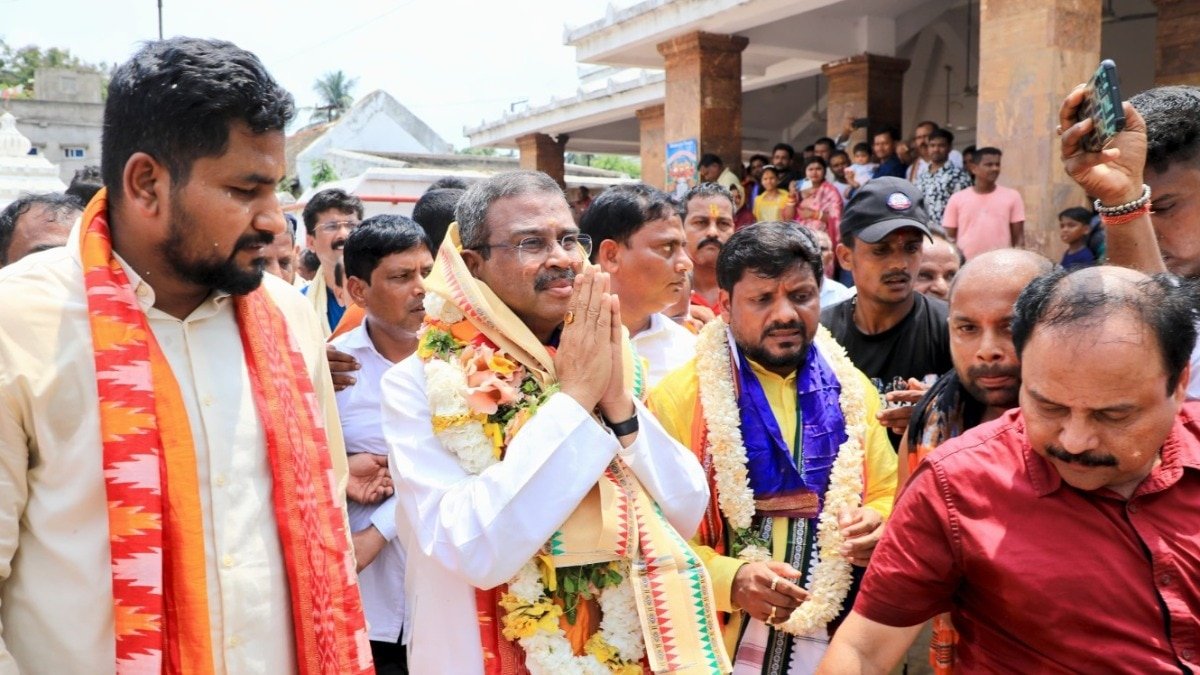
Dharmendra Pradhan, the Lok Sabha MP representing Sambalpur in Odisha, recently made headlines during the Deva Snana Purnima procession in Puri, as his resignation from his position as Union Education Minister triggered a flurry of political activity in the state. His return was met with a warm reception, raising questions about what this means for his future in the BJP.
Pradhan has been a significant figure in strengthening the BJP’s presence in Odisha, earning the loyalty of numerous MLAs and ministers, making him a key player in state politics. His arrival back in Odisha was framed by the BJP as a demonstration of strength, but political analysts in Bhubaneswar suggest it signals potential changes in his role within the party.
The welcome he received at Bhubaneswar airport, attended by multiple state ministers and MLAs, led many to speculate whether he could be in line for a leadership position, possibly even the Chief Minister’s role. This buzz has unsettled some within Odisha’s political landscape.
Pradhan’s resignation followed significant public outcry concerning examination irregularities, which led to demands for accountability. Despite stepping down from his ministerial role, Pradhan remains the MP for Sambalpur, and his return to Odisha has spurred theories about a shift in his political trajectory.
According to Rajaram Satpathy, a senior journalist and political analyst, the large turnout at the airport was telling and could be interpreted as an effort to rehabilitate Pradhan’s image following his resignation amid a public uproar over examination controversies. He noted that despite the challenges, Pradhan’s position within the BJP remains strong, as he is viewed as a significant Odia leader.
Yet, Satpathy points out that public sentiment toward Pradhan is mixed. Some see him as a victim of circumstances, while others criticize his failure to prevent the turmoil that led to his resignation.
The key question revolves around Pradhan’s next steps. Having been considered a frontrunner for the chief ministerial post after the BJP’s 2024 victory, the party instead nominated Mohan Charan Majhi. The decision has raised eyebrows and sparked discussions about the BJP’s strategy.
Looking ahead, Satpathy suggests two possible paths for Pradhan: he may choose to stay out of the limelight for a while, or the BJP could assign him a significant party role. However, discussions about his future inevitably return to the possibility of him aiming for the state’s top position.
Despite Pradhan’s extended tenure in Delhi, his influence in Odisha remains robust, with significant support from younger party members. The BJP holds 79 seats in the 147-member Odisha Assembly, and internal discussions hint at potential electoral strategies that could involve Pradhan’s candidacy in future elections.
Nevertheless, some analysts believe that while Pradhan’s experience in Delhi has enhanced his political acumen, it may not translate into immediate advantages in Odisha’s current political climate.
As the BJP navigates its internal dynamics amidst a resurgent BJD, the future of leaders like Pradhan will be closely watched.