



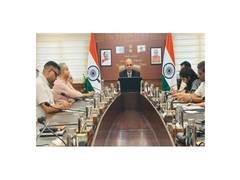
New Delhi [India], October 14 (ANI): The Ministry of Jal Shakti’s Department of Drinking Water and Sanitation (DDWS) convened a virtual meeting on Wednesday to promote better coordination between the Jal Jeevan Mission (JJM) 2.0 and VB-G RAM G, aiming to ensure reliable drinking water sources and enhance governance led by Gram Panchayats in rural communities.
This conference marked the third in a series of discussions following the Departmental Summit on Water 2026, which took place on September 1 and 2. During the event, DDWS Secretary Ashok KK Meena emphasized a shift in focus under JJM 2.0 towards maintaining and ensuring the long-term sustainability of rural drinking water systems established by the initiative.
Meena pointed out that dependable drinking water services necessitate systematic protection, groundwater recharge, and effective management of water sources, alongside ongoing maintenance of current infrastructure.
He noted that VB-G RAM G offers avenues for implementing water conservation, groundwater replenishment, and maintenance activities that directly enhance drinking water security.
Meena advocated for the integration of JJM Village Action Plans and Source Sustainability Plans with the Viksit Gram Panchayat Plans (VGPPs), incorporating these into the Gram Panchayat Development Plan (GPDP) process. He stressed that any interventions should be informed by scientific evaluations of local water resources and receive approval from the Gram Sabha.
Highlighting the importance of local institutions, Meena stated that Gram Panchayats and Village Water and Sanitation Committees (VWSCs) possess valuable insights into local water sources, seasonal changes, and community needs. Their active involvement in the planning, execution, and monitoring of these systems is vital for ensuring sustainable rural water access.
The Secretary encouraged states to utilize the Decision Support System (DSS) developed under JJM 2.0, along with the Yuktdhara Standard Operating Procedures (SOPs), to identify vulnerable drinking water sources and prioritize interventions based on scientific evaluations.
He mentioned various measures such as check dams, gully plugs, recharge shafts, injection wells, underground dykes, and rooftop rainwater harvesting systems that could be tailored to local hydrogeological conditions.
Meena also called for clearly defined procedures for technical review, approval, implementation, and monitoring of convergence projects. He highlighted the necessity for collaborative efforts among Rural Water Supply, Rural Development, and Panchayati Raj departments at the state, district, and Gram Panchayat levels.
He identified five key focus areas for states and union territories: aligning JJM plans with Gram Panchayat plans under VB-G RAM G; identifying source sustainability initiatives through DSS and Yuktdhara; establishing mechanisms for technical scrutiny and approvals; enhancing inter-departmental data sharing; and creating joint monitoring systems to evaluate implementation and water security outcomes.
During the meeting, Deeksha S Bisht, Assistant Commissioner in the Ministry of Rural Development, discussed the convergence potential between the two programs. She indicated that VB-G RAM G encompasses 128 water security-related initiatives, including groundwater recharge, rainwater harvesting, watershed management, rejuvenation of water bodies, source sustainability, and maintenance of water assets.
Bisht emphasized the need to prioritize water-related initiatives in areas facing stress based on groundwater classification and local demands. She also stressed the significance of water budgeting, hydrogeological assessments, and geospatial planning tools to identify appropriate interventions and optimize resource utilization.
States shared their experiences in implementing water conservation strategies and maintaining rural drinking water systems. Odisha showcased its efforts in groundwater recharge, greywater management, catchment treatment, source protection, and building climate-resilient water infrastructure, including community recharge pits and restoration of traditional water bodies.
Madhya Pradesh presented its strategies for implementing the Operation and Maintenance (O&M) Rules, 2026, and fortifying the role of Gram Panchayats in overseeing rural water supply projects, alongside model estimates for rainwater harvesting and source sustainability initiatives.
Rajasthan detailed its approach to preventive, corrective, and emergency maintenance of rural water supply systems through collaboration with VB-G RAM G, emphasizing the roles of Gram Panchayats, Paani Samitis, and Public Health Engineering Department staff in managing water supply assets.
Sumit Priyadarshi, Deputy Advisor at the National Jal Jeevan Mission, outlined the implementation framework for DSS, which aids in identifying drinking water sources at risk concerning quality and quantity. He urged states to utilize this system to prioritize interventions, validate risks through field assessments, and monitor the effects of mitigation strategies.
Assam shared its experience of employing DSS to pinpoint and verify water quantity-stressed villages using GIS mapping, field verification, standard operating procedures, and remedial action plans for vulnerable sources.
In closing, Kamal Kishore Soan, Additional Secretary and Mission Director of the National Jal Jeevan Mission, stated that investments under VB-G RAM G should address the drinking water challenges identified through DSS, leading to measurable enhancements in water security.
He noted ongoing efforts to integrate information on drinking water sources with their associated Gram Panchayats into the Rural Development Management Information System (MIS) for more efficient monitoring of planning, spending, and execution.
Soan urged states and union territories to ensure that District Collectors, Chief Executive Officers of Zila Panchayats, and field officials utilize DSS data to identify and prioritize vulnerable drinking water sources. He called for post-monsoon assessments, water source testing, field verification, and the development of suitable mitigation plans.
He further urged states to issue advisories to district-level officials, prioritize efforts in water-stressed areas, and formulate action plans for presentation at regional conferences scheduled for November 2026.
The conference concluded with a commitment from the Centre, states, and union territories to enhance collaboration between JJM 2.0 and VB-G RAM G, emphasizing scientific planning, coordinated execution, and Gram Panchayat-led governance to ensure sustainable drinking water sources and reliable rural water supply.