







In a week marked by significant military developments, Pakistan has shifted its approach to warfare, utilizing honey traps, Chinese communication devices, and testing a longer-range Fatah-4 missile. The Indian Navy has enhanced its capabilities with BrahMos missiles, and Air Marshal Dixit has been appointed as the new chief of the Indian Air Force.
On October 2, three individuals crossed into India from Pakistan in the Ferozepur sector of Punjab, disregarding multiple warnings from the Border Security Force (BSF) and were subsequently shot. The following day, India summoned Pakistani Chargé d’affaires Saad Warraich after Pakistan had protested the incident, claiming the shooting resulted in the deaths of two civilians. India’s Ministry of External Affairs responded by stating that this incident illustrates the consistent pattern of narcotics syndicates crossing the border from Pakistan and urged Islamabad to investigate its own border guards’ involvement. This marks the second time in a span of three weeks that India has called in the Pakistani envoy.
The Ferozepur incident highlights the ongoing traditional conflict, while other incidents reflect a new kind of warfare. On October 3, Andhra Pradesh Police’s counter-intelligence team apprehended Pradeep Mukherjee, a 31-year-old sailor stationed at INS Agrani in Coimbatore. Authorities allege that he was contacted on social media by an operative linked to Pakistani intelligence who gradually extracted sensitive information about naval fleet movements. Investigators are probing whether he received compensation through online transactions or through hawala.
Earlier, police in Bidar arrested 24-year-old BBA student Vishal Kumar Metre, who had been under surveillance since December 2025. His mobile phone reportedly contained conversations with Shahzad Bhatti, whose network was classified as a terrorist organization by the Home Ministry following the apprehension of over 200 individuals across 14 states, thwarting planned attacks prior to Independence Day. This marks the third terror-related arrest in Karnataka within 15 days.
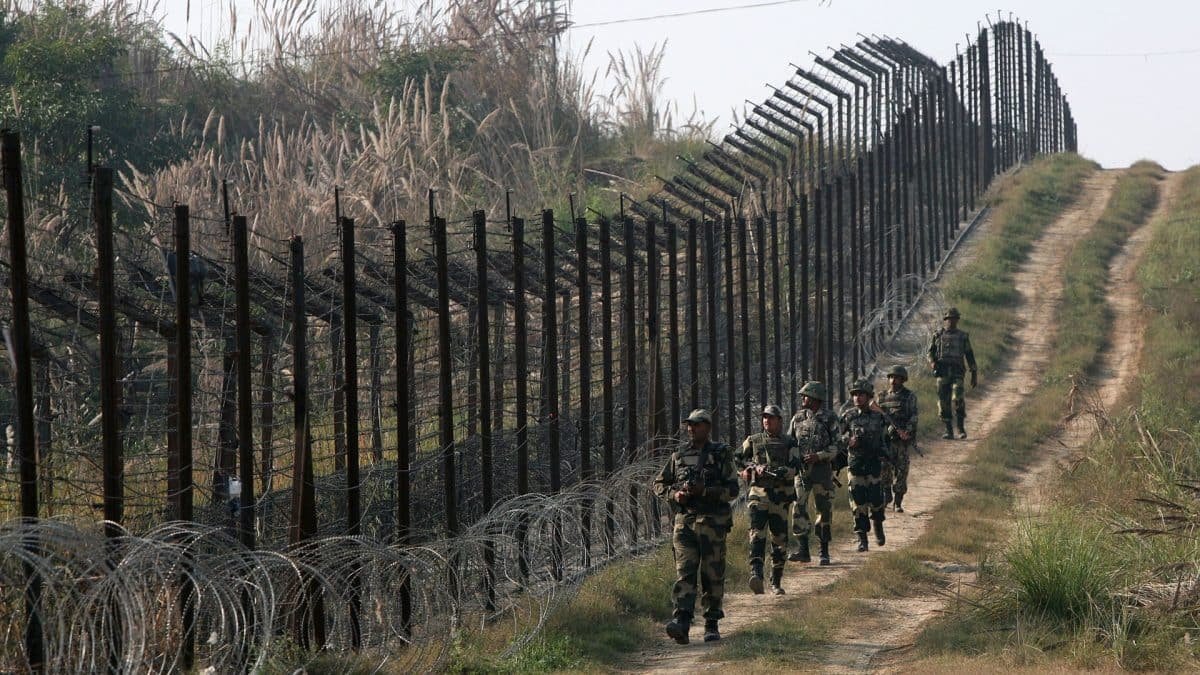
Pakistan’s strategy has evolved in light of increased difficulties in crossing the Line of Control (LoC) and the Punjab border, with enhanced fencing, thermal surveillance, drones, and intensified patrols leading to higher interception rates. Consequently, Pakistan has opted for fewer physical infiltrators and instead focuses on influencing Indian citizens through digital means.
Bhatti’s tactic exemplifies this new model, where a handler recruits a young individual online, enticing them with monetary rewards, flattery, or ideological appeals, ultimately connecting them with arms suppliers within India. This method eliminates the need for border crossings and the maintenance of training camps in Pakistan-occupied Kashmir.
For those who succeed in crossing the border, the tactics have also evolved. Security forces have encountered LoRa handsets on deceased terrorists, which operate without SIM cards or mobile towers, allowing for encrypted communications over distances of 10 to 15 kilometers.
These devices are part of a broader arsenal supplied by China, including Ultra Sets—Chinese radios tailored for the Pakistani military that function outside standard mobile frequencies and route messages through a control station in Pakistan.
Despite attempts to curb honey traps, this strategy continues to pose a significant threat. The Navy incident is part of a troubling trend that stretches back to Operation Dolphin’s Nose in 2019 and includes the case of DRDO scientist Pradeep Kurulkar in 2023. This method remains effective due to its simplicity and low cost.
Efforts to restrict access to social media have proven ineffective. Although the Army previously mandated the deletion of various apps, personnel are now allowed limited access to Instagram and X to view content, reflecting the reality that soldiers deployed in isolated locations maintain these platforms as vital connections to their families.
Looking ahead, it is likely that such incidents will continue to rise in sophistication. The next phase may involve AI-generated profiles that are increasingly difficult to identify as traps, along with recruitment of unemployed youth through gaming applications and private channels. The use of LoRa technology may also lead to coordinated drone drops of weaponry in Punjab.
India’s response must be equally multifaceted, emphasizing early detection training for soldiers, insider monitoring in sensitive areas, and the deployment of spectrum scanners tuned to LoRa frequencies in Kashmir’s forests. Additionally, traditional human intelligence remains unmatched by encrypted communications. Both recent arrests were made possible through digital tracking, highlighting the front lines of modern warfare.
On another front, on October 6, Pakistan launched an enhanced version of its Fatah-4 cruise missile, which has received praise from senior military leaders and the government. While the Inter-Services Public Relations (ISPR) has touted improvements in navigation and accuracy, the claimed range of this missile remains unverified, with estimates of 900 to 1,000 kilometers circulating but lacking confirmation.
This missile program is a strategic shift for Pakistan, particularly following failures experienced by its air force in May 2025 when attempts to target Indian assets were thwarted. The Fatah-4 is now being positioned as a solution to bypass the limitations of aerial assaults, drawing inspiration from China’s military doctrine that emphasizes a robust missile arsenal to compensate for weaker air and naval forces.
India cannot afford to underestimate this development. A cruise missile flying at low altitudes can evade ground-based radar, utilizing the terrain for concealment. When launched alongside drones and older missile systems, it is designed to saturate air defenses.
The Fatah-4’s association with Pakistan’s nuclear-capable Babur missile further complicates the situation, as it blurs the lines between conventional and nuclear capabilities, potentially escalating conflicts inadvertently. India has been preparing for these developments for years, investing heavily in detection systems capable of intercepting low-flying threats.
The Netra AEW&C aircraft have already proven their worth in combat and are set to enhance India’s surveillance capabilities further. India has also established a comprehensive defense network, integrating systems like the S-400 for long-range threats and MR-SAM and Akash for mid-range defense, ensuring a robust response to any potential attack.
Moreover, India’s offensive capabilities remain significantly more advanced than Pakistan’s, with the BrahMos missile system deployed on numerous Su-30MKIs, allowing for strikes deep within Pakistani territory. The ongoing arms race indicates that both nations must continuously adapt to the evolving landscape of modern warfare.