




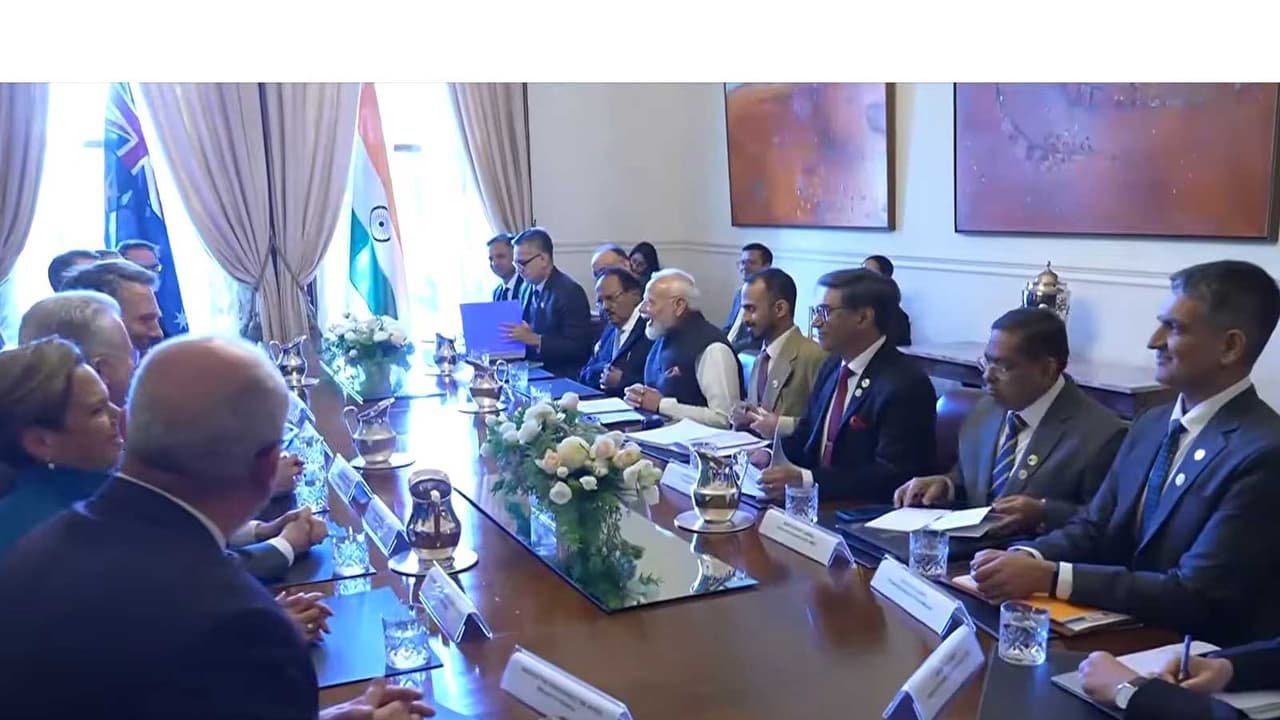
Prime Minister Narendra Modi and Australian Prime Minister Anthony Albanese wrapped up their annual summit in Melbourne on Thursday, enhancing their strategic collaboration significantly. The summit’s notable outcomes include a new defense and security declaration, advancements in trade agreements, and mutual efforts in energy, critical technologies, and maintaining a free Indo-Pacific region.
Taking place from July 8 to 10, the summit heralded a new chapter in the India-Australia Comprehensive Strategic Partnership (CSP). Both leaders emphasized the strong personal rapport they have developed over the years, which has acted as a catalyst for their robust strategic partnership.
Defense and Security Enhancements
The two leaders reiterated their dedication to broadening the CSP to tackle emerging challenges in a fast-changing global landscape. They introduced the Joint Declaration on Defence and Security Cooperation, describing it as a significant escalation in the depth and ambition of their bilateral defense relationship. This declaration positions defense collaboration as a cornerstone of their partnership and establishes an Annual Defence Ministers’ Dialogue to bolster strategic discussions.
Maritime Security Initiatives
Maritime security was a key focus, with the introduction of the ‘India-Australia Maritime Security Collaboration Roadmap’. The leaders highlighted the necessity of effective maritime cooperation for regional security and announced a Memorandum of Understanding between Australia’s Maritime Border Command and the Indian Coast Guard. This agreement aims to enhance interoperability, continue the General Rawat India-Australia Young Officers’ Exchange Program, host an Indian military instructor at the Australian Defence College by 2028-29, and explore a defense innovation framework linking industries and research institutions.
Economic and Industrial Collaboration
In terms of economic relations, the leaders acknowledged the ongoing growth in bilateral trade under the India-Australia Economic Cooperation and Trade Agreement (ECTA) and committed to advancing a Comprehensive Economic Cooperation Agreement (CECA) that would fully leverage the economic relationship. They recognized the synergies between India’s ‘Make in India’ initiative and Australia’s ‘Future Made in Australia’ policy, emphasizing the importance of transparent and resilient supply chains, particularly in critical minerals and advanced manufacturing.
Energy Security and Nuclear Cooperation
Energy security emerged as a pivotal theme, with discussions on enhancing uranium exports from Australia to India to support its ambitious goal of achieving 1,000 gigawatts by 2047. The finalization of the Administrative Arrangement under the Australia-India Nuclear Cooperation Agreement was welcomed, allowing for long-term Australian uranium exports to India for peaceful purposes under IAEA safeguards. Both leaders reiterated their commitment to the India-Australia Renewable Energy Partnership and initiatives like the Rooftop Solar Academy, while stressing that the Paris Agreement must embody equity and the principle of common but differentiated responsibilities.
Technological and Space Cooperation
The summit also saw the launch of the Australia-India Partnership on Cyber, Critical Technologies and Supply Chains (PACTS), aimed at elevating their collaboration in critical technologies, supply chain diversification, cybersecurity, digital resilience, and defense research. The leaders expressed enthusiasm for continued cooperation in the space arena, including Australia’s support for India’s Gaganyaan Human Space Flight Program through a temporary space tracking terminal on the Cocos (Keeling) Islands.
Cultural and People-to-People Connections
The enhancement of people-to-people ties was highlighted, with both leaders noting the importance of these links to the bilateral relationship. Prime Minister Albanese remarked on the value of Indian students in Australia, who are integral members of Australian educational institutions and communities. The leaders also acknowledged the establishment of campuses by Flinders University in Bengaluru and Victoria University in Gurugram, along with a National Centre of Excellence for Skilling in Mining in Odisha.
They also emphasized the role of sports in strengthening ties, looking forward to upcoming events like the 2030 Commonwealth Games in Ahmedabad and the 2032 Olympic Games in Brisbane. Additionally, they committed to the protection and preservation of cultural heritage, including the voluntary repatriation of ancestral remains from India and Australia.
Global Governance and Multilateral Cooperation
In the realm of global governance, Australia reiterated its support for India’s bid for a permanent seat on a reformed United Nations Security Council (UNSC). Both nations expressed mutual backing for each other’s non-permanent UNSC membership for the 2028-2030 term and emphasized the need for the UN to better reflect current geopolitical realities.
Addressing International Security
The leaders unequivocally condemned terrorism and violent extremism in all forms, denouncing recent attacks in Pahalgam and Bondi Beach, and called for action against UN-listed terrorist entities. They expressed concern over escalating tensions in West Asia and the humanitarian crisis stemming from the conflict in Ukraine, urging diplomatic solutions and adherence to international law. The leaders reaffirmed their commitment to ASEAN centrality and the implementation of the ASEAN Outlook on the Indo-Pacific.
At the conclusion of the summit, both leaders expressed satisfaction with the advancements made under the Comprehensive Strategic Partnership and reaffirmed their dedication to a