







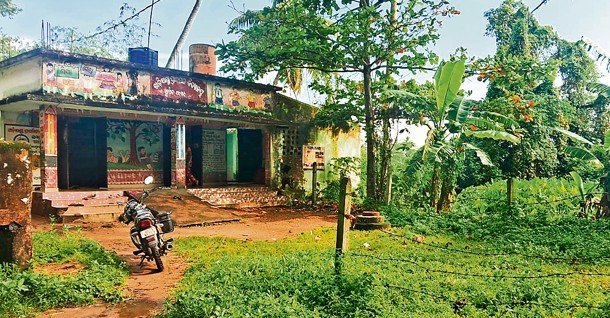
Pattamundai: Despite investments by the government in educational facilities, numerous rural schools in Odisha, including the Government Primary School at Khadianta in Kendrapada district, are still battling inadequate infrastructure, raising alarms over the quality of the learning environment for students.
Founded in 1939, the Khadianta school is experiencing a critical shortage of both teachers and classrooms, forcing students from Sishu Vatika to Class V to share a single room for their lessons.
Only two educators are available to manage the six different classes, and the lack of a boundary wall leaves the school open to external threats. Furthermore, the absence of an adequate playground detracts from the overall educational experience.
As a result of these poor conditions, some parents have opted not to enroll their children at the school; enrollment figures have decreased from 61 students in 2023 to just 49 currently. The sole classroom also serves as a storage area for cooking utensils and materials related to the midday meal program.
With two cupboards and two tables designated for school records taking up additional space, the environment for learning is severely compromised. However, the school does provide separate toilets and drinking water, with connections to the Swajal Dhara water supply initiative.
A nearby stream, overrun with weeds, is contributing to unsanitary conditions, and the state of a nearby cyclone shelter poses ongoing safety risks for students, leaving parents apprehensive.
Although the school has a kitchen for midday meals, the asbestos roof is in disrepair, allowing rainwater to leak in during storms and hindering meal preparation, forcing students to eat on the verandah.
Headmistress Pushpamanjari Biswal expressed her concerns about the various infrastructure problems facing the school and noted that the Block Education Officer (BEO) had been made aware of these issues.
Smrutiranjan Mallik, president of the school management committee, highlighted that the stream surrounding the institution is filled with weeds and rubbish, effectively turning it into a dumping site. “Students are compelled to learn in such unhygienic conditions,” he lamented. Mallik pointed out that while the government’s Sankalp campaign promotes cleanliness and environmental responsibility, the situation at Khadianta Primary School contradicts these efforts. He called on the administration to take prompt actions to build a boundary wall, hire more teachers, and create additional classrooms, rather than just offering pledges.
BEO Ajit Barik confirmed he was aware of the issues and had informed the district administration about them. Block Development Officer (BDO) Sheetal Agarwal acknowledged the challenges faced by the school and mentioned that improvements to classrooms and infrastructure would commence once funding is secured.