







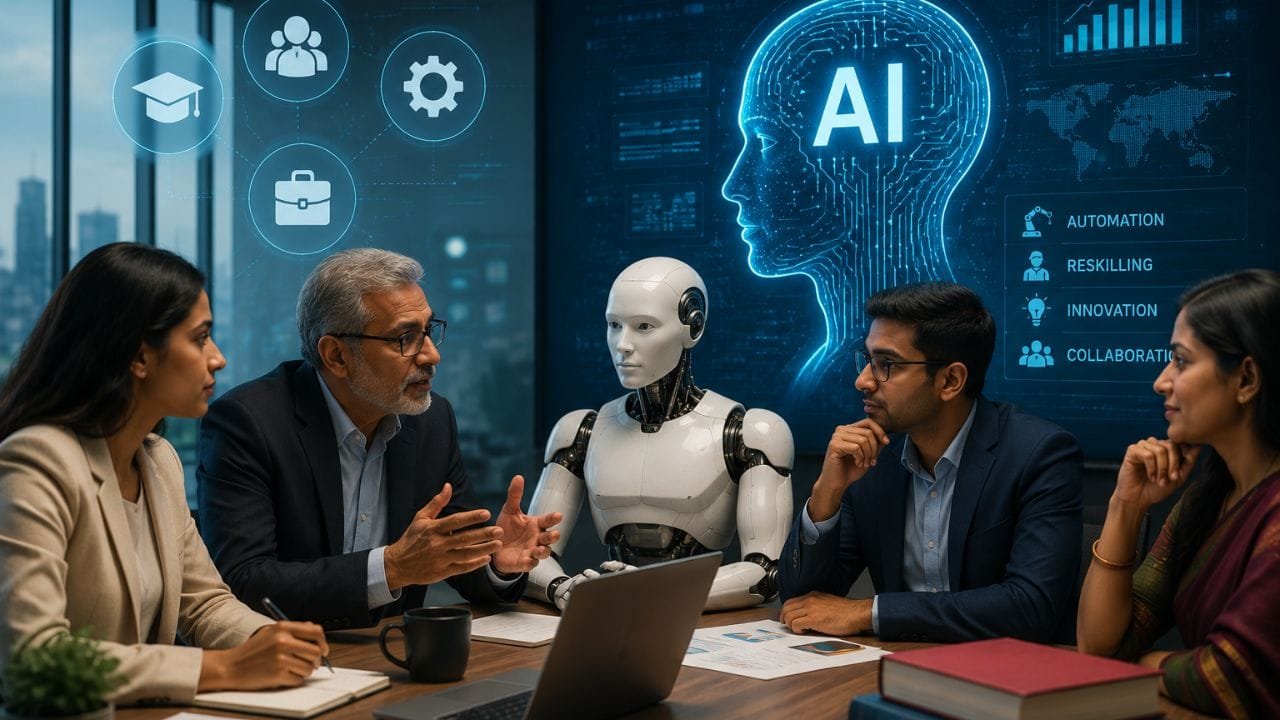
The rise of artificial intelligence is significantly altering business operations, prompting urgent discussions about which jobs will flourish, diminish, and how workers can prepare for these changes. Four experts from various sectors, including recruitment, finance education, AV technology, and higher education, shared their insights.
Devashish Sharma, Co-Founder and CEO of Taggd, believes AI will increase the demand for roles focused on creating, governing, and applying technology to solve business challenges. He notes that jobs based on routine tasks will not disappear entirely but will undergo fundamental transformations.
According to CFA Sanjay Saraf, Founder of the Sanjay Saraf Educational Institute (SSEI) in Kolkata, there is a growing need for professionals skilled in AI, data analytics, cybersecurity, risk management, investment research, and fraud detection. He highlights the importance of combining domain expertise with technological skills, while warning that roles most susceptible to automation include routine data entry, standard reporting, and templated research. Saraf emphasizes that the real threat lies not in AI replacing jobs but in those adept at utilizing AI outpacing those who cannot.
Vijay Sharma, Managing Director of Optoma Technology (India), anticipates a surge in demand for skills related to AI integration, automation, data science, cybersecurity, software development, and advanced AV systems. He suggests that manual data entry, administrative roles, and customer service functions are likely to be significantly automated.
Dr. Lovi Raj Gupta, Pro Vice-Chancellor of LPU, reflects on historical shifts in technology, asserting that each advancement, such as the introduction of computers in banking and railways, has redefined work rather than eliminating it. He identifies positions most at risk as those centered around repetitive tasks.
Sharma of Taggd lists essential technical competencies for future careers, including AI and Generative AI, machine learning, data science, Python, SQL, cloud engineering, cybersecurity, and full-stack development. However, he stresses that critical thinking, judgment, adaptability, empathy, and stakeholder management will increasingly influence success, as “AI can accelerate the process, but human judgment, context, and relationships will determine the outcome.”
Saraf outlines three critical capabilities for finance professionals: a solid grasp of accounting and valuation, technology and data literacy (including skills in Excel, SQL, Python, and AI tools), and independent judgment that enables professionals to challenge assumptions and discern insights from data.
Vijay Sharma highlights the need for ongoing education rather than fixed skill sets, advocating for digital literacy, AI proficiency, critical thinking, creativity, communication, and teamwork.
Dr. Gupta asserts that the most crucial skill is not merely knowing how to use AI tools but understanding how to apply them to real-world challenges, complemented by analytical capability, ethical reasoning, and business acumen.
He observes that recruiters are increasingly prioritizing practical abilities over formal qualifications, valuing live projects, internships, and portfolios more than theoretical education.
Sharma mentions that companies are actively mapping skill requirements to identify workforce gaps and cites TARA Insights, an AI recruitment tool developed by Taggd, as a means to gain visibility into talent supply and emerging skill requirements.
Saraf advocates for a collaborative approach that involves government investment in affordable reskilling and vocational training, educational institutions shifting from exam-centric learning to AI literacy and hands-on projects, and corporations redesigning entry-level positions to provide young professionals with early opportunities in analysis and decision-making.
Vijay Sharma emphasizes the importance of cooperative efforts in lifelong learning and modular credentialing, with government support for subsidized training and businesses integrating upskilling into daily operations.
In the AV sector, he identifies skills in network engineering, IoT cybersecurity, and AI system integration as critical priorities.
Dr. Gupta urges that curricula must remain flexible through ongoing collaboration with industry, a practice LPU adheres to in line with the National Education Policy. He adds, however, that curriculum updates alone are insufficient.
Students should engage in internships, hands-on industry projects, and gain multidisciplinary experience before graduation, with institutions treating employability as an ongoing process rather than just a placement goal.