






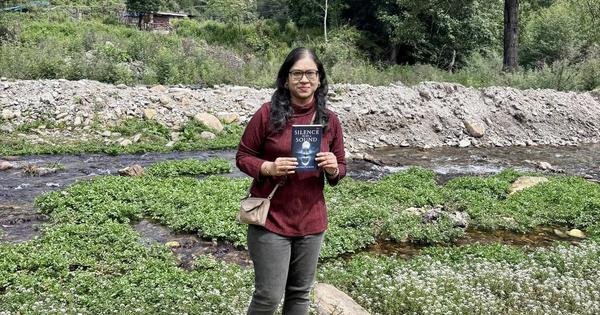
The anthology presents a captivating exploration of themes surrounding memory, desire, and the profound nuances of silence.
In the realm of poetry, silence often signifies more than mere absence; it evolves into a dimension where meanings can be redefined or entirely erased. Mitra Samal’s ‘Silence Has a Sound’ embodies this paradox. This marks her second poetry collection and is organized thematically into five segments: Nostalgic Reflections, Realities, Celebrating Nature, Yearnings, and The Weight of Silence. The majority of the poems within these sections convey a sense of deep intimacy and heartfelt confession, often set against a backdrop of domestic life.
The first section, Nostalgic Reflections, introduces many recurring motifs including feelings of displacement, childhood memories, and familial closeness. The remnants of the past intrude upon the present, revealing fractures in time, as illustrated in the poem ‘I Like Old Walls’:
Then there is one
with the shadows of photo frames,
and nails where perhaps a map once hung,
a map that must be no longer valid,
with places that have changed names
and borders that have shifted.
A poignant sense of longing permeates ‘Leave,’ where she expresses:
I may leave this place for a while,
but it will remain
with me forever.
This yearning resurfaces in ‘Reminiscence’:
Oh, how it aches
to be distant from one’s native land
to be lost in a sea of strangers.
In ‘Photograph,’ memory embodies a mode of mourning:
How can I live your dream, granny?
How can I possibly
even live?
The poem ‘Grandma’s Smile’ reflects on missed opportunities with her grandmother:
Had I spent more time with her,
might I have seen that smile again
perhaps a truly happy one?
Ageing emerges as another prevalent theme, particularly in ‘There Will Come a Time,’ where she laments the reduction of women to mere objects of desire:
There will come a time when you will
no longer be stared at or admired
as a symbol of beauty.
The second section, Realities, marks a shift from self-reflection to societal critique. ‘A State Bleeds’ addresses the indifference toward violence in Manipur, while ‘Come Out God’ highlights the hypocrisy of performative religiosity, asserting that divinity dwells in suffering:
the divinity for the poet
rests in the naked,
ominous darkness.
Additionally, she questions religious color codes in ‘Green’:
I am not more Hindu in orange or ochre,
nor does green make me a Muslim.
In ‘The World as a Book,’ her humanist ideals shine through as she envisions a world where language barriers dissolve:
It would belong to no language,
speaking only in the tongue of the heart
a treasure for all people,
where borders dissolve,
merging into the lines of pages,
never to be separated again.
The third section, Celebrating Nature, evokes a pastoral atmosphere, with many poems drawing on nature as a narrative device. In ‘You Are Poetry to My Eyes,’ nature is personified as a lover:
You are poetry to my eyes,
and I live only for it,
for everything else is meaningless.
‘Reminds Me To Live’ captures the essence of being rejuvenated by nature:
The whisper of the wind
rustling through leaves… quiet that escapes
from deep woods,
reminds me
to live again.
In ‘Sunset,’ she critiques the relentless pace of urban life:
It doesn’t pause anymore,
doesn’t feel anymore
it is growing too fast.
Memory resurfaces in ‘Moment,’ where the poet expresses anxiety about time:
I will never
learn to conquer time…
but it will always remain
a thing of the past.
In the fourth section, Yearnings, Samal showcases her evocative talents, channeling a Plath-like sensibility throughout several pieces. ‘Find Me Love’ speaks to the yearning for love in solitude:
Find me love that stands beside you
when no one else does
when your cronies turn away
yet your beloved still beholds you.
In ‘Union,’ she intertwines sensuality with artistry:
If you become the rain
and pour from the sky,
I will let each transparent drop
paint me with hope
let it trickle down my body.
‘Empty’ grapples with heartbreak:
where I meant to write
a sad poem for you,
but a hollow silence
settled in my mind.
In ‘When I Remember You,’ she reflects on love that neither hurts nor brings joy:
It lingers like a faraway, untold dream
untouched, unfathomed.
The final section, The Weight of Silence, synthesizes the themes explored throughout the collection. Silence becomes a tangible presence, interwoven with memory and desire. In ‘Seizure,’ the poet navigates the dissonance experienced during such moments, ultimately finding solace in simple gestures:
I rise, murmur that I’m okay… and begin to walk away.
The poem ‘Sleep’ offers a contemplative approach to resistance and recovery. Previous themes of haunting memories recur in ‘Abandoned House,’ where the poet likens unkept promises to ghosts of the past. ‘Silence Divine’ encapsulates the spiritual revelation that unfolds in silence:
That silence had a sound,
softly floating into my senses,
lifting me into something
almost divine.
The titular poem reflects on silence as a state of introspection, suggesting it possesses sound when whispers fill the space while the mind remains captivated.
However, the use of familiar imagery and symbols can limit aesthetic exploration. Samal’s straightforward expression fosters emotional closeness, albeit at the expense of ambiguity. Overall, the collection compellingly navigates themes of memory, desire, and the personal experience of silence. It hints at the potential for rich psychological exploration, even if not entirely realized, with moments of quiet reflection offering a rare contemplative quality in contemporary poetry.
Abhik Ganguly is a poet, writer, and scholar-practitioner currently pursuing a PhD at the Department of English, University of Delhi.