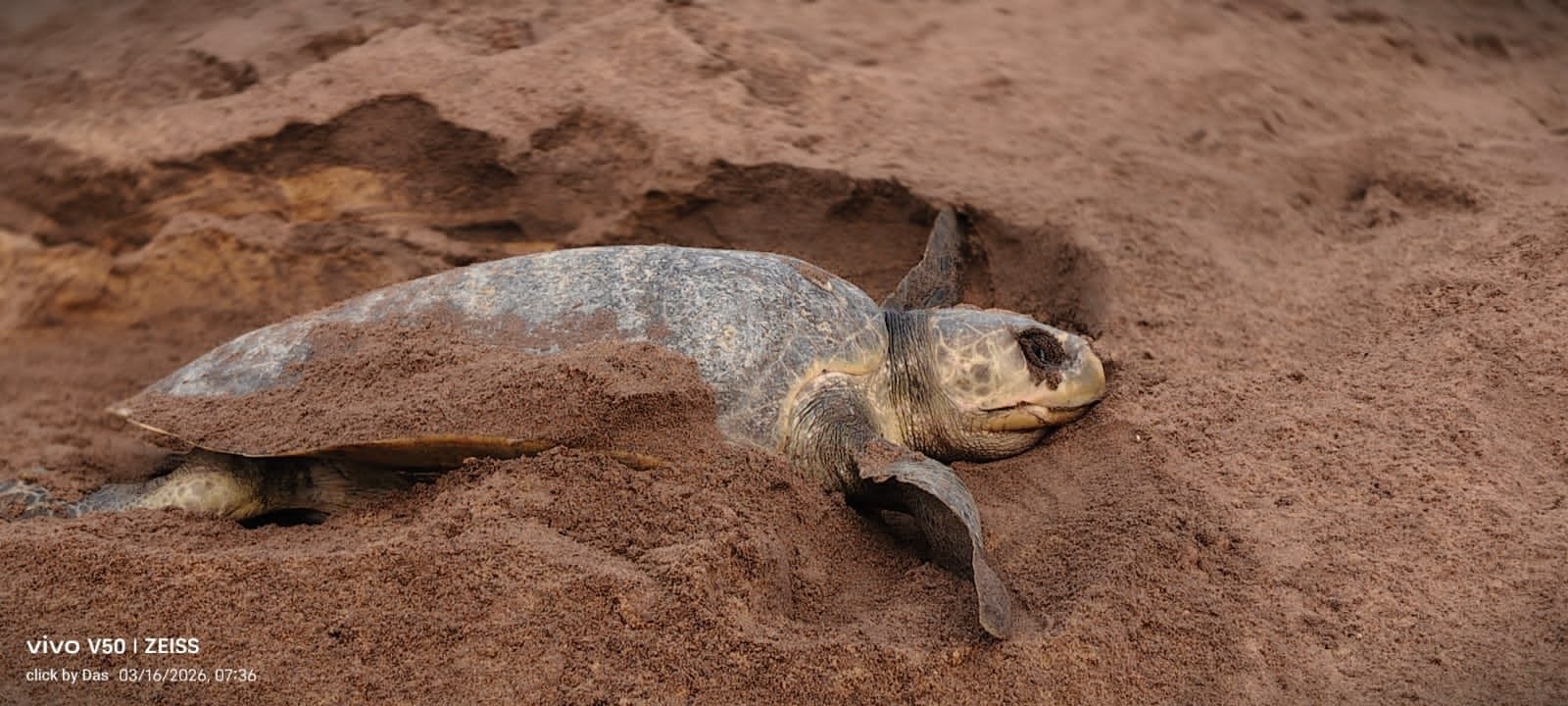







KENDRAPARA: Fishing cats have been observed scavenging on the remains of Olive Ridley turtles within the mangroves of Bhitarkanika National Park, providing new insights into the dietary habits of this elusive wild cat species, according to researchers from the Wildlife Institute of India (WII).
Scientists documented two separate instances of fishing cats feeding on deceased Olive Ridley turtles in the Odisha mangroves. These findings serve as rare direct evidence of scavenging behavior among fishing cats, which are typically recognized for their hunting prowess.
The first sighting occurred on February 29, 2024, during a camera-trap survey in the Rajnagar range of Bhitarkanika National Park. Researchers found a turtle carcass on a mudflat, and further investigation revealed several pugmarks surrounding it along with pieces of flesh that had been dragged. Govindan Veeraswami Gopi, one of the researchers, noted that the pugmarks matched the size and measurements of a fishing cat.
A second instance was recorded on the night of January 28, 2025, when a fishing cat was photographed feeding on another Olive Ridley carcass. This observation reinforced the notion that fishing cats in this region utilize deceased marine animals as a food source.
Bhitarkanika National Park, located in the delta formed by the Brahmani and Baitarani rivers in Kendrapara district, is a vital mangrove ecosystem. This area, alongside the Gahirmatha coast, is essential for the feeding and breeding of Olive Ridley turtles, which are classified as vulnerable.
Fishing cats are predominantly found in the mangroves and floodplains of eastern and southeastern Asia, and in India, they are mainly associated with coastal mangrove areas. Their diet typically includes various prey such as fish, crabs, mollusks, amphibians, reptiles, and small mammals; however, documented instances of scavenging have been sparse.
The mortality of Olive Ridleys in the region is primarily due to fishing practices, particularly trawling, where turtles are inadvertently caught in nets and drown. These carcasses, along with those of saltwater crocodiles and dolphins, may serve as a crucial food source for fishing cats and other scavengers.
The significance of these findings is underscored by the fact that most previous knowledge regarding fishing cats’ feeding habits has stemmed from scat analysis, which does not definitively indicate whether the animal was hunted or scavenged.
This study was published in CATnews, the journal of the IUCN/SSC Cat Specialist Group, in its Summer 2026 issue. Other researchers involved in the study include Bijoy Kumar Das, Ajinkya Bankar, and CS Ashik.