


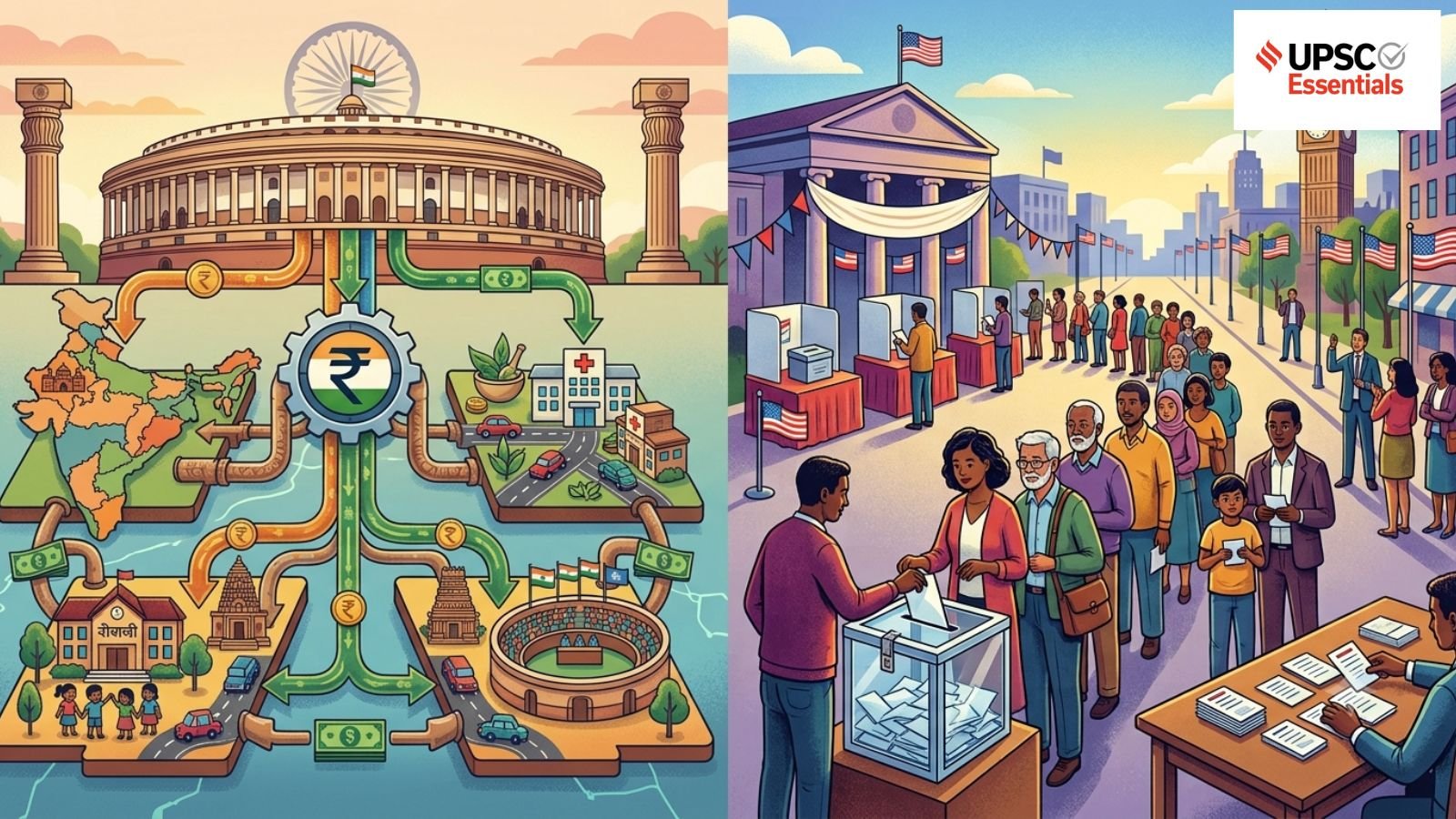


UPSC Essentials introduces a new initiative aimed at enhancing answer writing skills for the Mains examination. This program addresses significant topics within both static and dynamic components of the UPSC Civil Services syllabus, specifically in various GS papers. Participants are encouraged to tackle today’s questions related to GS-2, allowing them to assess their progress.
As we celebrate the third anniversary of the UPSC Essentials magazine, we extend our gratitude to our readers for their invaluable support. Your feedback and trust have motivated us to continually enhance our publication. Click here to read the September 2026 issue of UPSC Essentials. We invite you to share your thoughts and suggestions in the comments or reach out via email at manas.srivastava@indianexpress.com.
QUESTION 1
The allocation of taxing powers between the Union and the States is vital to India’s federal system. Analyze this in light of the recent adjustments to the legal framework regarding taxation of mineral rights and mineral-rich lands.
QUESTION 2
The effectiveness of electoral democracy is heavily reliant on the accuracy, inclusiveness, and transparency of electoral rolls. Evaluate the institutional mechanisms in place for maintaining electoral rolls in India.
Discussion on Question 1
This inquiry relates to GS Paper 2 – Federalism, focusing on the constitutional allocation of legislative and taxation powers between the Union and the States. Recent modifications regarding the taxation of mineral rights and lands provide a contemporary perspective on the tensions between Centre and State.
Introduction:
The distribution of taxing authority between the Union and the States is a critical aspect of India’s federal framework. The recent enactment of the Mines and Minerals (Development and Regulation) Amendment Act, 2026, which restricts states from imposing specific levies on mineral rights and lands, has reignited discussions about fiscal autonomy, resource governance, and the necessity for a cohesive national framework.
Body:
Consider integrating the following points into your response:
- Constitutional Framework: The Indian Constitution delineates legislative and taxing powers through the Seventh Schedule, aiming to provide States with a sufficient revenue-generating capacity while enabling the Union to manage national issues.
- Significance of 2026 Changes: The recent amendments aim to curtail the ability of states to impose certain taxes on mineral resources, contingent on conditions set by the Centre. This could restrict resource mobilization for mineral-rich states.
- Economic Impact: For states like Odisha, Jharkhand, and Chhattisgarh, mineral revenue is crucial. Estimates suggest that mining and petroleum earnings constituted 23% of Odisha’s, 13% of Jharkhand’s, and 5% of Chhattisgarh’s revenue for the fiscal year 2024-25. Thus, limiting state levies may disproportionately affect economies reliant on mineral resources.
- Union’s Position: The Union government argues that excessive and inconsistent state taxes can inflate mineral costs, escalate infrastructure expenses, and create price disparities across states. They advocate for a stable taxation framework to enhance investment in mining, highlighting a policy conflict between state revenue autonomy and the goal of a consistent national resource market.
- Local Consequences: Many local impacts of mining, including environmental degradation and community strains, are borne by the states. At the same time, minerals are vital for the national economy and fulfill essential national needs. Consequently, the discussion broadens beyond taxation to encompass how the benefits and costs of natural resources are distributed among different government tiers.
- Judicial Insights: A 2024 Supreme Court ruling bolstered states’ rights to generate revenue from mineral resources, though subsequent legislation sought to restrict certain state levies, raising concerns about balancing parliamentary authority, judicial interpretation, and fiscal federalism.
Conclusion:
The debates surrounding mining taxation highlight the ongoing transformation of fiscal federalism in India. While the push for national consistency and investment certainty may warrant reducing mineral-related taxes, it is essential to preserve significant fiscal authority for the states.
Long-term solutions should ensure industry certainty, fair revenue for resource-rich states, and enhanced Centre-State dialogue, aligning resource governance with the principles of cooperative federalism.
Points to Ponder
How can the Centre effectively balance national economic interests with the fiscal independence of resource-abundant States?
Relevant Previous Year Questions
How successful has the Indian federal framework been in accommodating regional and cultural diversities? Discuss the role of asymmetric federalism and suggest improvements for dispute resolution mechanisms (2026).
Analyze the changing dynamics of Centre-State financial relations concerning planned development in India. How have recent reforms impacted fiscal federalism? (2025)
Discussion on Question 2
This question is pertinent to UPSC GS Paper 2 – Election and Representation, as it reviews the legal and institutional framework for the creation, revision, and maintenance of electoral rolls. The adoption of digital platforms like ERONET and ECINET underscores the importance of technology, transparency, and accountability in managing electoral rolls.
Introduction:
The integrity of elections is influenced not just by the outcomes but also by the accuracy, inclusivity, and transparency of electoral rolls, which must comply with established statutory standards. Recent advancements such as SIR, ERONET, and ECINET have highlighted these institutional challenges.
The electoral roll serves as the foundation of the electoral process, as only individuals listed on it are entitled to vote. In India, the Representation of the People Act, 1950, along with the Registration of Electors Rules, 1960, governs the creation and updating of electoral rolls, with the Election Commission of India (ECI) providing constitutional oversight over the electoral process.
Body:
Consider including the following points in your answer:
- Institutional mechanisms for maintaining electoral rolls
[Article truncated for processing]