





To successfully navigate the journey from exploration to sale in India’s offshore oil and gas sector, five critical steps must be accomplished: accurately mapping geological formations, securing drilling rigs, constructing long-lasting wells, identifying buyers, and maintaining contractual agreements. The current status of India’s offshore exploration efforts raises important questions.
In recent years, India has expanded access to its offshore regions for oil and gas exploration, with an investment of Rs 84,084 crore aimed at supporting drilling operations. Historically, two main barriers have hindered progress in this sector: the need for permissions and the availability of capital. Fortunately, both obstacles have now been addressed.
The initial phase of the National Offshore Exploration Scheme, set to run until 2030-31, involves an expenditure of Rs 84,084 crore, primarily covering drilling costs. The government is prepared to subsidize up to half the expenses of deepwater exploration wells, alleviating the financial burden.
Additionally, previous restrictions on offshore areas due to defense concerns have been gradually lifted since 2022, allowing companies to explore over a million square kilometers of India’s maritime territory.
A notable case illustrating the complexities of oil and gas exploration is the development of Cluster-2 within the KG-DWN-98/2 block, located in waters up to 3,200 meters deep off the coast of Andhra Pradesh. Here, ONGC invested Rs 34,012 crore, initially discovering gas in June 2020 and later oil in January 2024. However, production levels have since dropped significantly, highlighting that the discovery alone is just the beginning of a lengthy process.
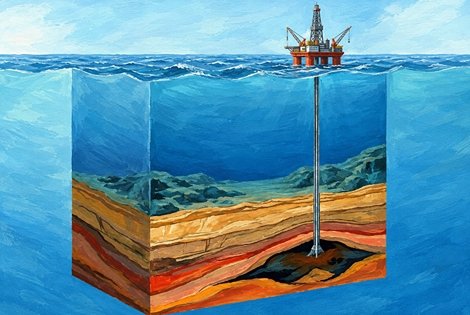
Producing oil and gas involves several crucial stages following the initial discovery, including precise geological mapping to determine drilling locations. A recent example from the Andaman Islands demonstrates this need. In September 2025, Oil India found gas at the Sri Vijayapuram-2 well, followed by another discovery at the Vijayapuram-3 well in June 2026. However, determining the best site for the next well remains a challenge.
To gain insights into what lies beneath the ocean floor, companies utilize sound waves to create geological profiles. In the Andaman-Nicobar basin, however, this process is complicated by hard coral reefs that distort the sound data. As a result, much of the subsurface remains poorly understood, with only 13 test wells drilled over a vast area of approximately 47,000 square kilometers.
Even with recent discoveries, the understanding of the basin is limited, relying on outdated data from surveys conducted between 1986 and 2002, with the most recent reanalysis in 2010. The challenges in mapping the geological formations complicate the process of selecting drilling sites.
Once a drilling location has been identified, the next hurdle is securing a rig. This process is hindered by government procurement regulations, as demonstrated by ONGC’s cancellation of a tender for jack-up rigs due to rising costs. Despite the apparent high prices, they were still lower than global rates, revealing a disparity in pricing perceptions between local and international markets.
To effectively bridge this gap, India could consider offering longer contracts, adjusting procurement regulations to align with global pricing, or even establishing a state-owned offshore drilling company.
Building a well is the most capital-intensive phase and one that is often misunderstood. A deepwater well must remain operational for many years amidst natural geological pressures. For instance, in Cluster-2, soft sands can infiltrate the well, causing equipment damage and necessitating closures, as seen in nearby Reliance’s KG-D6 block.
Cluster-2’s construction faced additional issues due to its complexity, with over 35 separate contracts leading to coordination problems and increased costs. Despite planning for some challenges, production levels have fallen short of expectations, raising concerns about the geological conditions thousands of meters below the surface.
In summary, while India’s offshore oil and gas exploration initiatives have made significant strides, the path to successful exploration and production involves overcoming numerous technical and financial hurdles.